Commercial Outdoor LED Lighting in Dallas, Frisco, Plano & Fort Worth: Parking Lots, Facades, Signage & Site Lighting Across DFW
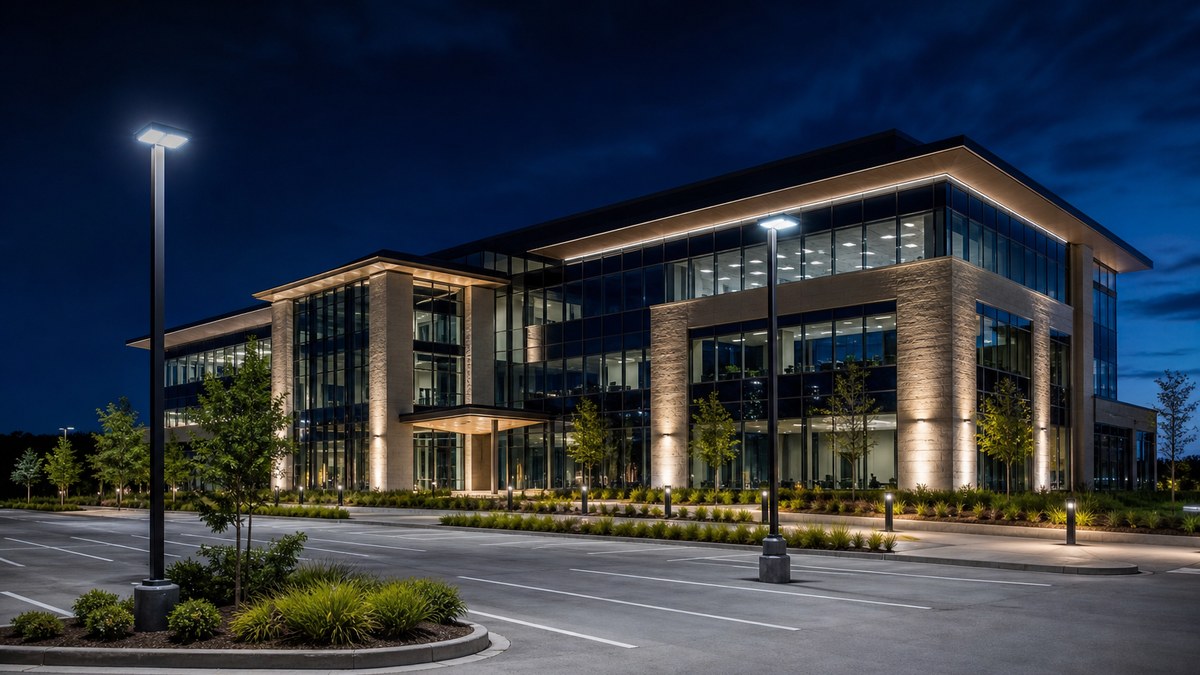
Commercial outdoor lighting in Dallas, Frisco, Plano, Fort Worth and the rest of the DFW metroplex has one job before any other: make a property safe, easy to find and comfortable to use after dark. Done well, it also makes a building look like the best address on the block. Parking lots, drive aisles, building facades, entrances, canopies, wall packs, monument signs and landscaped grounds all have to work together, and they have to survive North Texas heat, hail, wind and storms year after year.
This guide is written for property owners, facility managers, developers, general contractors and architects across DFW. It explains the main types of exterior LED lighting, how parking lot and site lighting is designed, how facade and permanent architectural lighting works, what controls and energy codes expect, how city lighting rules differ from place to place, and how to plan a retrofit or new-construction project. Irving LED Lights is based in the Irving and Las Colinas area and works on commercial projects throughout the metroplex, so you will also find notes on how projects typically differ between Dallas, Frisco, Plano, Fort Worth and nearby cities.
Commercial outdoor LED lighting covers every light on the outside of a business property. A complete DFW exterior lighting plan usually includes:
- Site and parking lot lighting: pole-mounted area lights with the right optical distribution for each lot
- Building-mounted lighting: wall packs, wall sconces and soffit downlights at doors and walkways
- Facade and architectural lighting: wall washing, grazing, linear accents and color-capable permanent lighting
- Canopy and entry lighting: drive-throughs, porte-cocheres, fuel and loading canopies
- Signage and landscape: monument signs, building letters, trees and pathways
- Controls: photocells, astronomic time clocks, dimming and motion sensing to meet energy code
- Built for Texas: heat-rated drivers, surge protection, sealed optics and poles engineered for wind
- Pricing: quote-only, prepared per property after a site review
Why exterior lighting matters for DFW businesses
Outdoor lighting is often the last line item on a building budget and the first thing a visitor notices at night. In a metroplex where people drive almost everywhere, the parking lot and the walk from car to front door shape how safe and welcome customers, tenants, guests and employees feel. Good commercial exterior lighting delivers several kinds of value at once:
- Safety: even, glare-controlled light on drive aisles, crosswalks, curbs and steps reduces trips, falls and vehicle conflicts.
- Security: uniform lighting removes dark pockets, supports camera coverage and makes a site feel watched.
- Wayfinding: lit entrances, signs and drive paths help first-time visitors find the right door quickly.
- Brand and curb appeal: a well-lit facade and monument sign signal a cared-for, professional property.
- Energy and maintenance: LED fixtures with controls typically use far less energy than older metal halide and high-pressure sodium systems and need far fewer lamp changes.
- Longer operating hours: restaurants, retail, hotels, fitness centers and logistics yards keep working well after sunset.
If you are focused on one property type, our guides to retail and shopping center LED lighting, warehouse and logistics lighting and hotel lighting go deeper on each.
The building blocks of commercial outdoor LED lighting
Parking lot and area lights
Pole-mounted area lights are the backbone of most DFW commercial sites. Modern LED area lights use precise optics to put light on the pavement instead of into the sky or onto neighboring property. Choosing the right optical distribution for each pole location matters as much as choosing the fixture itself, which is why parking lot lighting should be laid out with a photometric plan rather than by replacing fixtures one for one.
Wall packs and building-mounted lights
Wall packs light the perimeter of a building, service doors, loading areas and walkways. Older wall packs were often the biggest source of glare on a site. Full-cutoff LED wall packs and architectural wall sconces direct light downward, look cleaner, and pair easily with photocells and motion sensors.
Canopy lights
Drive-through lanes, hotel porte-cocheres, fuel islands, bank drive-ups and loading canopies need bright, uniform light from a low mounting height. Low-profile LED canopy fixtures provide even coverage while keeping glare out of drivers' eyes.
Facade and architectural lighting
Wall washers, grazers, linear LED graze lights, narrow-beam accent projectors and color-capable fixtures bring out the architecture of glass towers, stone and brick facades, columns and parapets. This is where a property moves from simply lit to memorable.
Bollards, pathways and landscape
Bollards, step lights, uplights on trees and accent lights on planters lead people from parking to entrances and make the grounds part of the experience. See our guide to commercial landscape lighting for techniques and fixture choices.
Signage lighting
Monument signs, channel letters, pylon signs and building identification all depend on lighting that is bright enough to read without overpowering the rest of the site. Our network partner offers LED signage and digital displays, and we coordinate sign lighting with the rest of the exterior package.
Outdoor fixture types at a glance
| Fixture | Typical DFW use | What to look for |
|---|---|---|
| LED area / shoebox lights | Parking lots, drive aisles, truck courts | Correct optical distribution, low BUG rating, house-side shields where needed, dimmable driver |
| Full-cutoff wall packs | Building perimeter, service doors, docks | Downward light, photocell or sensor option, sealed housing |
| Architectural wall sconces | Entries, storefronts, office facades | Warm color, up/down or downlight distribution, finish to match the building |
| Canopy fixtures | Drive-throughs, porte-cocheres, fuel and loading canopies | Low profile, wide even distribution, glare control |
| Flood and accent projectors | Facades, flags, columns, sculpture | Interchangeable beam angles, locking aim, glare visors |
| Linear grazers and wall washers | Glass, stone and brick facades | Even distribution, outdoor rating, color options, DMX or DALI control where needed |
| Permanent color-capable trim lighting | Rooflines, parapets, eaves, holiday and event looks | Outdoor-rated linear or point sources, controller with scheduling and scenes |
| Bollards and step lights | Walkways, plazas, accessible routes | Low glare, impact resistance, even ground distribution |
| Sign and monument lights | Monument signs, building letters | Even illumination, concealed source, vandal resistance |
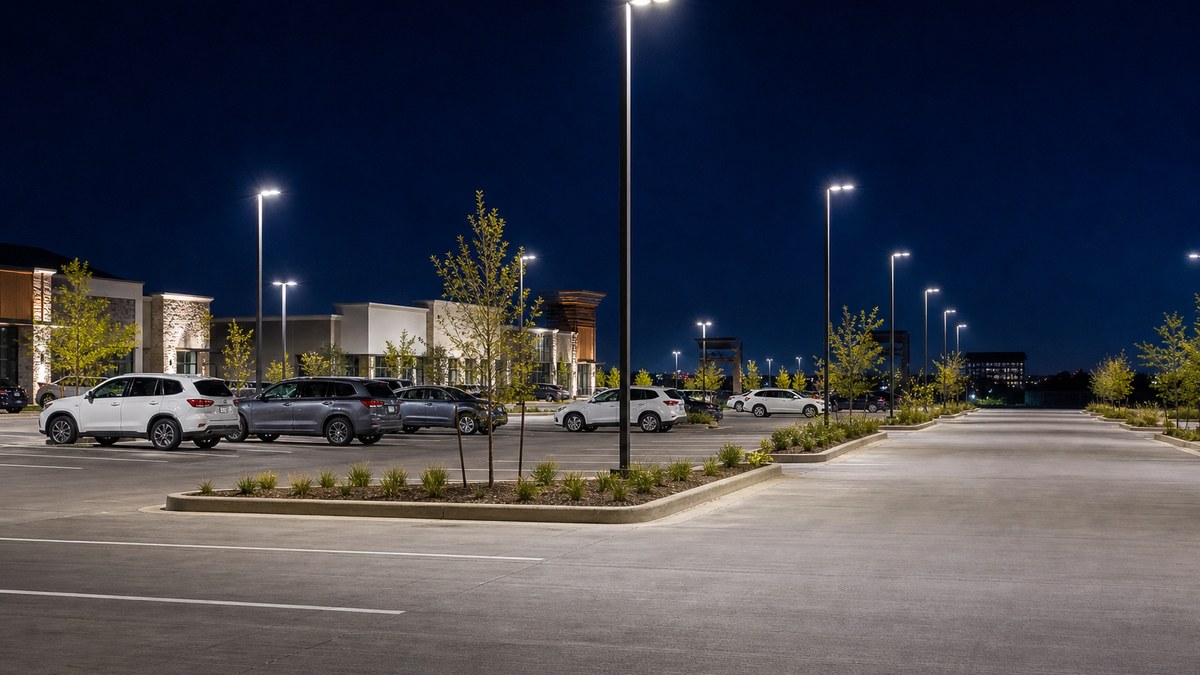
Parking lot lighting done right
Parking lots are where most exterior lighting budgets go and where most problems show up: dark spots between poles, glare that blinds drivers, light spilling into nearby homes, and fixtures that stay at full output all night when the lot is empty. A good parking lot lighting design starts with the site, not the catalog.
- Photometric plan first. A lighting layout calculates light levels and uniformity across the lot so the design meets your goals and any city requirements before anything is ordered.
- Right distribution for each pole. Poles along a property line, in the middle of a lot, or at a corner each need a different optical pattern to light the pavement without spilling past the edge.
- Uniformity over brightness. People see better in evenly lit lots than in lots with bright hot spots and deep shadows. Uniform light also helps security cameras.
- Glare and BUG control. Backlight, uplight and glare (BUG) ratings help compare how much light a fixture sends where it should not go. Many DFW cities look closely at uplight and light trespass.
- Reuse poles when sound. Existing poles and bases can often stay if they are structurally sound, which simplifies a retrofit. Damaged, rusted or undersized poles should be replaced and checked for wind loading.
- Dim when the lot is empty. Dimming drivers with motion sensors or scheduled dimming cut energy use late at night while keeping a base level of light for security.
For structured parking, see our separate guide to parking garage LED lighting, which covers decks, ramps, stair towers and entrance transitions.
Walk the lot at night before you approve a retrofit. Look for dark zones between poles, glare from wall packs, neighbor complaints, and areas where cameras struggle. Those observations should drive the design, not the number of old fixtures on the site.
Facade lighting and permanent architectural lighting
A lit facade turns a building into a landmark along the highways and tollways that define DFW. Whether it is a glass office tower, a hotel, a medical office building or a retail center, facade lighting uses a few proven techniques:
- Wall washing spreads soft, even light across a large surface for a clean, premium glow.
- Grazing places light close to stone, brick or textured panels to reveal depth and shadow.
- Accent lighting highlights columns, entries, canopies, flags and signature details.
- Linear outlining traces rooflines, parapets and fins so the building's shape reads from a distance.
- Color-capable lighting lets a building stay warm white most nights and switch to holiday, team, cause or brand colors on schedule.
Permanent color-capable trim and facade lighting has become popular with retail centers, restaurants, hotels and office buildings because it replaces the cost and hassle of hanging temporary holiday lights every year. Fixtures stay in place, scenes are programmed in a controller, and the property can celebrate seasons and events without a lift truck. The key is choosing outdoor-rated fixtures, discreet mounting, and a control system that a facility team can actually use. Effects, color shows and custom programming are scoped and quoted as part of the project.
For more detail on architectural and facade projects, see our architectural lighting services and our Irving-focused guide to commercial outdoor LED lighting for facades and parking.
Get a site review and a clear quote
Dallas, Frisco, Plano, Fort Worth or Irving: tell us about your property and we will follow up with a project-specific proposal.
Controls and energy code for exterior lighting
Exterior lighting runs every night of the year, so controls are where most of the long-term savings come from. Energy codes adopted by Texas cities, based on editions of the International Energy Conservation Code (IECC) or ASHRAE 90.1, generally require automatic shutoff in daylight and time-based or occupancy-based reductions for much exterior lighting. The exact requirements depend on the code edition each city has adopted and the type of project, so always confirm with the local building department.
- Photocells switch lighting on at dusk and off at dawn automatically.
- Astronomic time clocks follow sunrise and sunset through the seasons and handle schedules for closing time.
- Scheduled dimming lowers light levels late at night while keeping safety lighting on.
- Motion sensing on poles and wall packs brings light up when a car or person arrives and drops it when the area is empty.
- Networked and wireless controls let a facility team see, schedule and adjust every exterior zone from one dashboard, often alongside interior lighting.
- Scene control for facades and color-capable lighting handles everyday, holiday and event looks.
Our guides to lighting controls and energy code compliance and commercial lighting control systems explain the options in more detail. Don't forget the exit discharge path: emergency lighting at exterior doors and along the route to a safe area is covered in our guide to emergency and egress lighting.
City lighting rules differ across DFW
One of the biggest differences between projects in Dallas, Frisco, Plano, Fort Worth, Arlington, Richardson and Irving is how each city regulates outdoor lighting. Many DFW cities include outdoor lighting standards in their zoning or development codes, covering items such as fixture shielding, light trespass at property lines, maximum pole heights, color temperature, and when photometric plans must be submitted. Frisco, for example, has outdoor lighting regulations in its zoning ordinance with dark-sky provisions, and its rules have been updated in recent years.
Because these rules change and vary by zoning district and project type, we treat local requirements as a design input on every project:
- Confirm the current outdoor lighting rules with the city's planning or building department.
- Prepare a photometric plan when the city requires one for new construction, site changes or permits.
- Choose fully shielded fixtures and appropriate color temperature where dark-sky rules apply.
- Coordinate with property managers, HOAs or owner associations that have their own standards.
- Use licensed electricians and pull permits where required.
Built for North Texas weather
DFW exterior lighting faces some of the toughest conditions in the country: long, hot summers, hailstorms, high winds, heavy rain and frequent lightning. Fixtures that work fine in milder climates can fail early here. Specify for the climate:
| Condition | What to specify |
|---|---|
| Summer heat | Drivers and fixtures rated for high ambient temperatures, good heat sinking, quality components |
| Hail and impact | Durable lenses and housings, protected placement for low fixtures |
| High winds | Poles and bases engineered for local wind loads and fixture weight; check existing poles before reuse |
| Lightning and storms | Surge protection at fixtures and panels, proper grounding |
| Heavy rain and irrigation | Appropriate ingress protection, sealed connections, drained in-grade fixtures |
| UV exposure | UV-stable finishes, lenses and cable jackets |
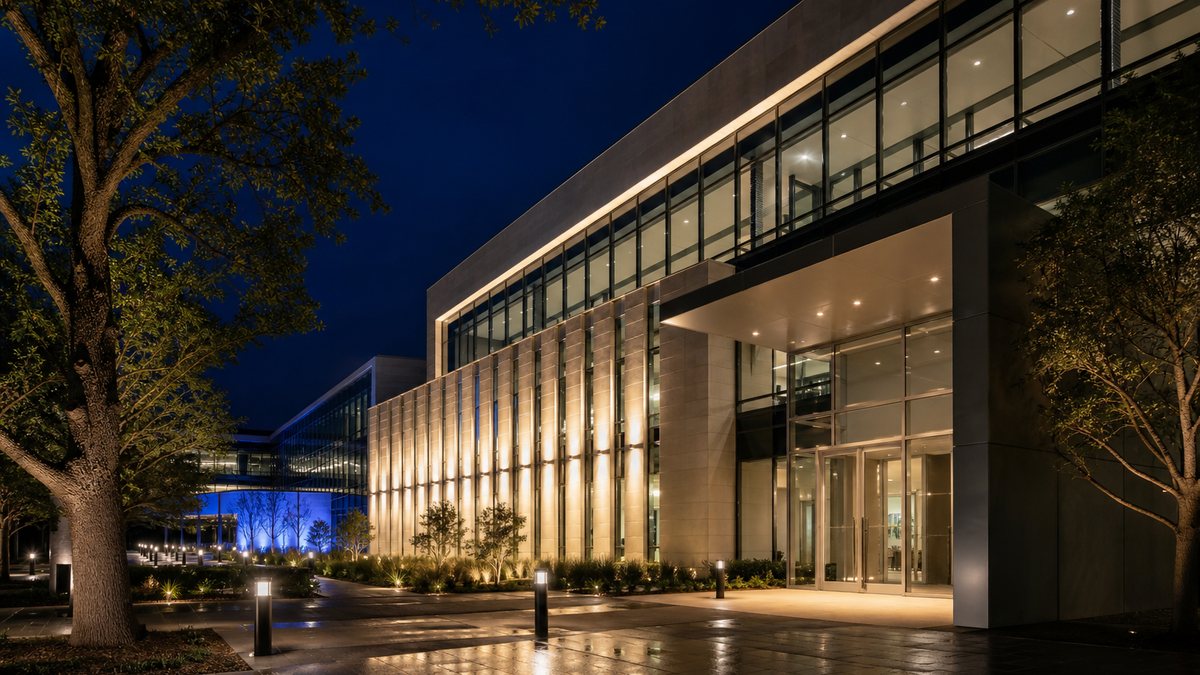
Outdoor lighting by city: Dallas, Frisco, Plano, Fort Worth & more
Every city in the metroplex has its own mix of property types, so exterior lighting priorities shift from place to place. Here is how projects commonly differ.
Dallas
Dallas projects range from downtown and Uptown towers to suburban office parks, medical buildings, shopping centers and industrial sites. Facade lighting, parking structure and surface lot upgrades, and retrofits of aging metal halide site lighting are common. Our network site for Dallas commercial LED lighting covers the city in more depth, and our Dallas and Texas LED buyer's guide explains how to choose the right lighting partner.
Frisco
Frisco's fast growth means a lot of new construction, mixed-use developments, sports and entertainment venues, corporate campuses and retail. Outdoor lighting plans there should account for the city's outdoor lighting standards from the start, with shielded fixtures and photometric plans that are ready for review.
Plano
Plano is home to large corporate campuses, office parks and retail corridors. Campus-style properties benefit from coordinated site, facade, pathway and landscape lighting on networked controls. See our partner site for Plano LED lighting.
Fort Worth
Fort Worth projects often include industrial and logistics sites, hospitality, entertainment districts and historic buildings where facade lighting has to respect the architecture. Our partner site for Fort Worth LED lighting focuses on the west side of the metroplex.
Arlington, Richardson and the mid-cities
Arlington's entertainment district, Richardson's office and technology corridors, and mid-cities retail and industrial properties all share the same priorities: safe parking, clear entrances and controls that cut overnight energy use. See Arlington LED lighting for that market.
Irving, Las Colinas and nearby cities
Our home base. Canal-side plazas, hotels, corporate campuses and logistics sites near DFW Airport are a core part of our work. We also serve nearby cities, covered in our guides to Coppell and Valley Ranch and Grapevine, Highland Village and Grand Prairie. See our full service areas.
Outdoor lighting by property type
| Property type | Exterior lighting priorities |
|---|---|
| Office buildings and campuses | Parking, entry plazas, facade identity, pathways between buildings, networked controls |
| Retail and shopping centers | Even parking lot light, storefront canopies, signage, holiday and event lighting |
| Hotels and hospitality | Porte-cochere, facade, pool and courtyard, warm welcoming color |
| Restaurants and entertainment | Patios, drive-throughs, facade and sign visibility, color-capable accents |
| Warehouses and logistics | Truck courts, dock doors, yard lighting, motion-based dimming |
| Medical and senior living | Safe walkways, low glare, steady light at entrances around the clock |
| Multifamily and mixed-use | Parking, amenity areas, pathways, light trespass control near residences |
| Churches and institutions | Parking, entrances, grounds and signature architecture for evening events |
Retrofit or new fixtures?
Most existing DFW sites are candidates for an LED upgrade. The right approach depends on the condition of what is already there:
- Retrofit kits can work when housings and poles are in good shape and the existing layout already lights the site well.
- New fixtures make sense when housings are corroded, optics are poor, the layout leaves dark zones, or you want integrated sensors and dimming.
- Re-layout is worth considering when the site has changed, such as new buildings, new drive aisles, or new city requirements.
- Phased upgrades let a property start with the highest-impact areas, such as main parking fields and entrances, and finish the rest later.
Incentives may help. Depending on location and program availability, commercial lighting upgrades in the Oncor service area may qualify for utility incentive programs. We can help you check current options when we prepare your quote. For more on getting the most from a budget, read our guide to affordable commercial LED lighting upgrades.
What affects your quote
Irving LED Lights is a quote-only company: every exterior lighting project is priced after a site review because no two properties are alike. These are the factors that shape the scope:
| Factor | Why it matters |
|---|---|
| Site size and layout | Number of poles, fixtures, circuits and control zones |
| Retrofit vs new | Reusing sound poles and housings versus new fixtures, poles or bases |
| Fixture types and finishes | Area lights, wall packs, canopies, facade and decorative fixtures |
| Controls | Photocells and clocks versus dimming, motion and networked systems |
| Facade and color lighting | Architectural fixtures, mounting, programming and custom effects |
| Electrical and civil work | Wiring condition, trenching, boring, pole bases and panel capacity |
| City requirements | Photometric plans, permits and dark-sky compliance |
| Access and scheduling | Lift access, night work, occupied sites and phasing |
How a DFW outdoor lighting project runs
- Consultation. We learn about the property, goals, problems and timeline.
- Day and night site review. We document existing fixtures, poles, wiring, dark zones, glare and neighbor concerns.
- Lighting plan. Fixture selections, layout, photometrics where needed, and control zones.
- Proposal. A clear scope and project-specific quote, with phasing options if helpful.
- Permits and coordination. City submittals where required and coordination with property managers and contractors.
- Installation. Licensed installation, scheduled to keep the property open and safe.
- Night aiming and programming. Final aiming, schedules, dimming and scenes set after dark.
- Service. Ongoing support, adjustments and maintenance through our service team.
Common outdoor lighting mistakes to avoid
- One-for-one replacement without a plan. Swapping old fixtures for brighter LEDs can increase glare and still leave dark spots.
- Too cool, too bright. Very cool white light at high output feels harsh and can conflict with local lighting rules.
- Ignoring light trespass. Light spilling into nearby homes leads to complaints and code problems.
- No controls. Lights at full output all night waste energy and may not meet energy code.
- Mismatched systems. Parking, facade, landscape and sign lighting in different colors and schedules look disjointed.
- Overlooking poles. New heads on corroded or undersized poles can be a wind-load risk.
- Choosing on fixture price alone. Optics, drivers, surge protection and warranty support matter more over the life of the system.
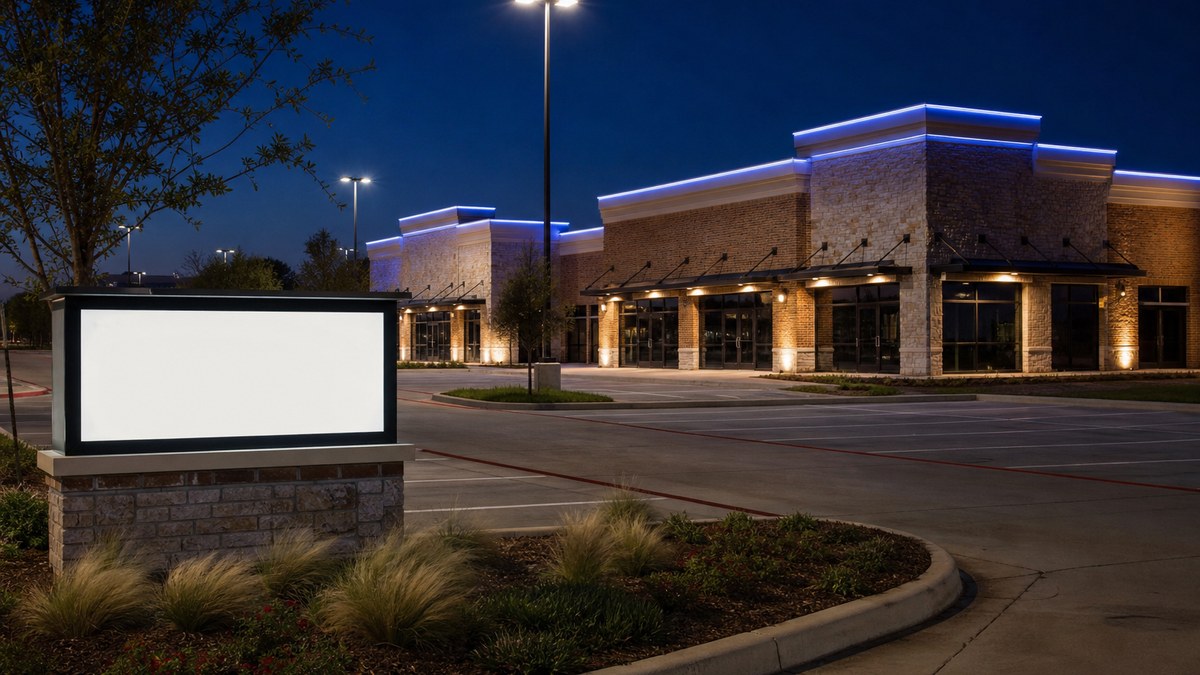
Why work with Irving LED Lights
We design, supply, install, program and service commercial lighting across Irving, Las Colinas and the DFW metroplex, including parking lot, facade, canopy, signage, landscape and building lighting, so every part of your exterior works as one system. We bring 15+ years as an authorized architectural lighting dealer and project coordinator. Our licensed installation partner has completed over 200 major sports and commercial projects across the US and Canada — NFL, NBA, NHL, MLS, NCAA and NASCAR. Learn more about us, explore our commercial lighting services, or see our Luminance design-build program for complete lighting transformations. For interior and exterior video, see our guide to LED video walls across DFW.
Frequently Asked Questions
What is commercial outdoor LED lighting?
How much does commercial outdoor lighting cost in Dallas or Frisco?
Do DFW cities have outdoor lighting rules for businesses?
What color temperature is best for commercial outdoor lighting?
Can I keep my existing parking lot poles when upgrading to LED?
What controls does exterior lighting need for energy code?
What is permanent architectural or holiday lighting for businesses?
Are there rebates for outdoor LED lighting upgrades?
Which DFW cities do you serve?
How do I start an outdoor lighting project?
Light your DFW property the right way
Parking lots, facades, signage and grounds anywhere in the metroplex: request a quote and we will follow up to schedule a site review.
Related
Our DFW lighting network: Dallas commercial LED lighting, Fort Worth LED lighting, Arlington LED lighting, Plano LED lighting, statewide Texas LED lighting, wholesale LED components, fiber optic starlight ceilings, 360° fiber optic lighting, LED signage, modular building solutions, and Dallas modular structures.