Parking Garage LED Lighting in Irving, TX: Retrofits, Controls, Security & Code
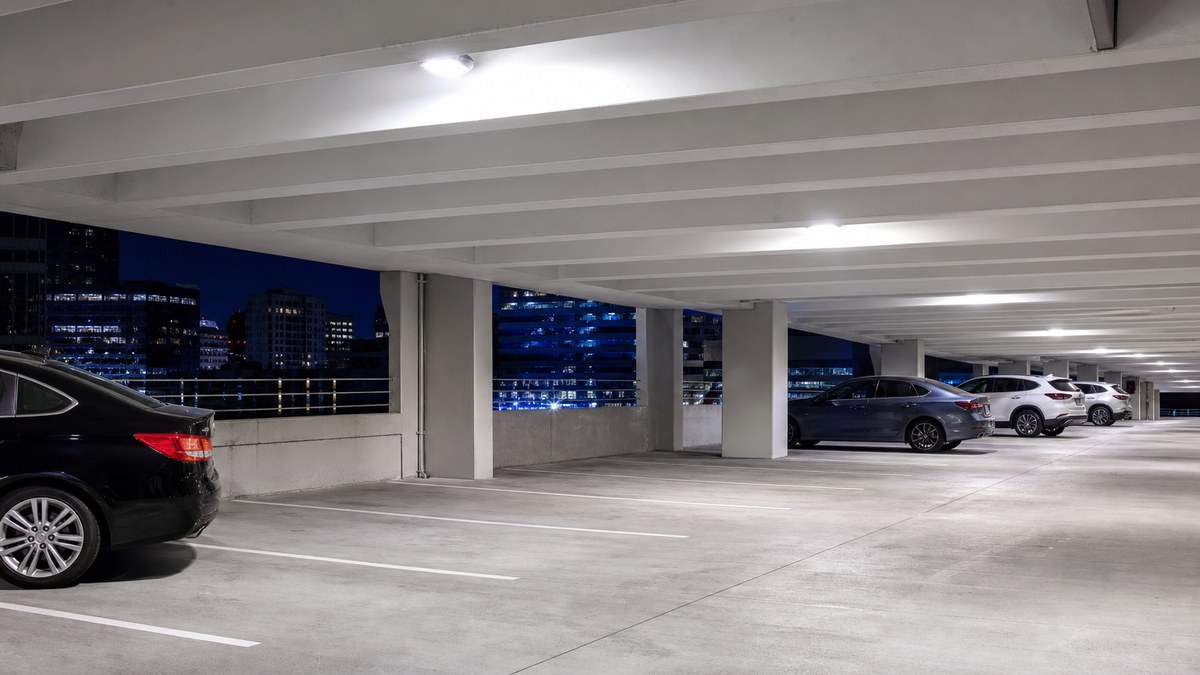
Parking garage LED lighting in Irving is often the first and last impression a building makes. Every tenant at a Las Colinas office tower, every guest at a hotel near the convention center, and every employee at a campus along the DFW Airport corridor starts and ends the day on a parking deck. If that deck is dim, patchy, or full of flickering fixtures, people notice, and they remember it. A well-designed LED garage is bright where it needs to be, comfortable to drive through, easy to watch on camera, and much easier to maintain than the older systems it replaces.
This guide explains how commercial parking garage lighting works and what to plan for in Irving: fixture types for low ceilings and open decks, the entrance "adaptation" zone, security and camera coverage, lighting controls and current energy code requirements, North Texas conditions, retrofit versus full redesign, and how a project runs from site walk to final programming. It is written for property managers, building engineers, owners, developers, and parking operators who want a garage that feels safe and costs less to run.
A modern parking garage lighting system uses durable, low-glare LED fixtures with built-in sensors and networked controls to keep decks bright and uniform when people are present and dimmed when they are not.
- Fixtures: low-profile LED garage fixtures with wide distributions for low ceilings and drive aisles
- Uniformity: even light between columns and parking stalls, without dark pockets or harsh hot spots
- Entrances: a brighter daytime transition zone so drivers' eyes can adjust
- Controls: occupancy sensing, daylight response near open sides, and scheduling
- Security: vertical light on faces and vehicles, plus lighting that supports cameras
- Code: newer IECC editions include specific parking garage control requirements
- Pricing: quote-only, prepared per garage after a site review
Why parking garage lighting matters so much
Parking structures are unusual spaces. Most of them run lighting around the clock, they have low ceilings and long sight lines broken up by columns, and they combine moving cars with people on foot. That mix makes lighting a safety system, a security system, and a large line item on the electric bill all at once. Good garage lighting delivers:
- Pedestrian safety: drivers can see people stepping out between parked cars, and pedestrians can see curbs, ramps, wheel stops, and changes in grade.
- Driver comfort: even lighting without glare makes it easier to read signs, judge clearance, and find a space.
- Personal security: bright, uniform light reduces hiding spots and helps people feel comfortable walking to their cars late at night.
- Camera performance: security cameras need consistent light on faces, plates, and vehicles to capture usable images.
- Lower operating costs: LED fixtures with controls use far less energy than older lamp-based systems, and they need far less maintenance.
- Property value and leasing: tenants judge a building by its parking experience. A bright, clean garage supports the Class A positioning many Irving properties aim for.
For the surface lots, building facades, and site lighting that surround a garage, see our guide to commercial outdoor LED lighting in Irving. This article focuses on the structure itself: covered decks, ramps, stair and elevator cores, and the open roof level.
The zones of a parking garage and what each needs
A garage is not one space. Each zone has a different job, and the lighting design should treat them differently.
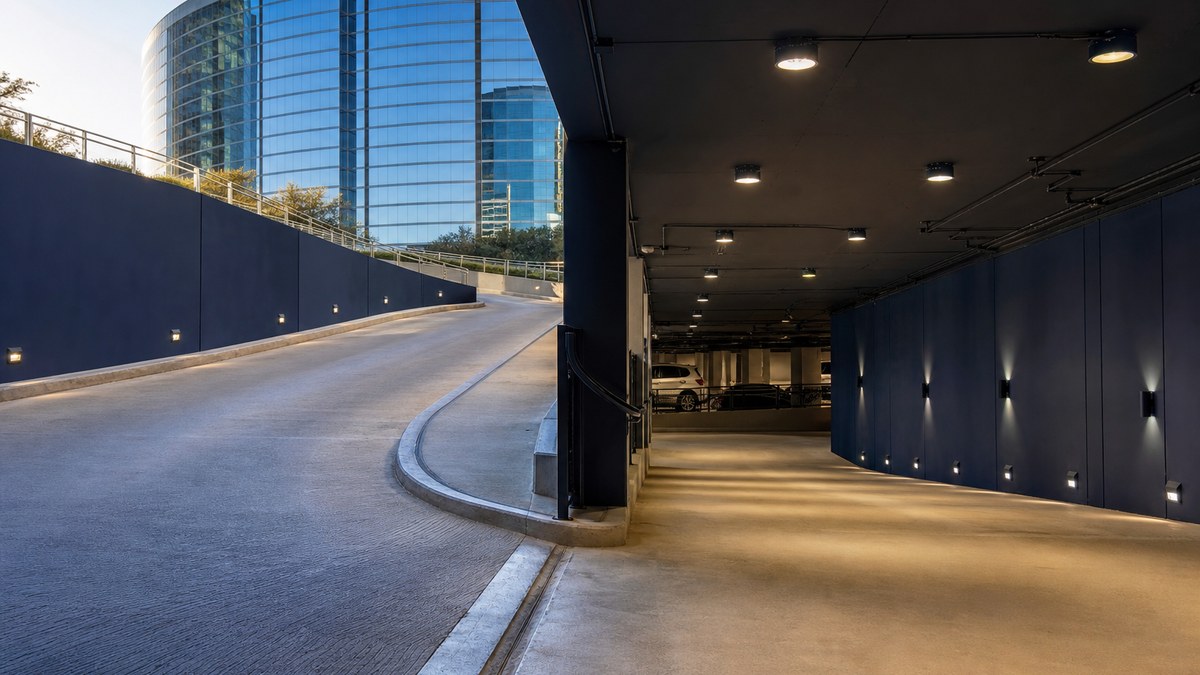
Entrances and exits
During the day, a driver coming in from bright Texas sunshine into a covered deck is effectively driving into a dark tunnel. The eye needs time to adapt. That is why lighting guidance for parking facilities calls for a brighter entrance or "adaptation" zone during daylight hours, stepping down to normal deck levels farther inside. At night the situation reverses, and the entrance zone can be dimmed so it does not glare out toward the street.
Drive aisles and ramps
Aisles and ramps need even, continuous light so drivers can see the path, other cars, and pedestrians crossing. Ramps deserve extra care because sight lines are shorter and the ceiling angle changes, which can put fixtures directly in a driver's view.
Parking stalls
Light needs to reach between parked vehicles, not just the center of the aisle. Fixture placement and distribution matter here: a fixture with a wide, batwing-style distribution can spread light into stalls and onto vehicle sides, which helps people find keys, load cargo, and feel secure.
Stair towers and elevator lobbies
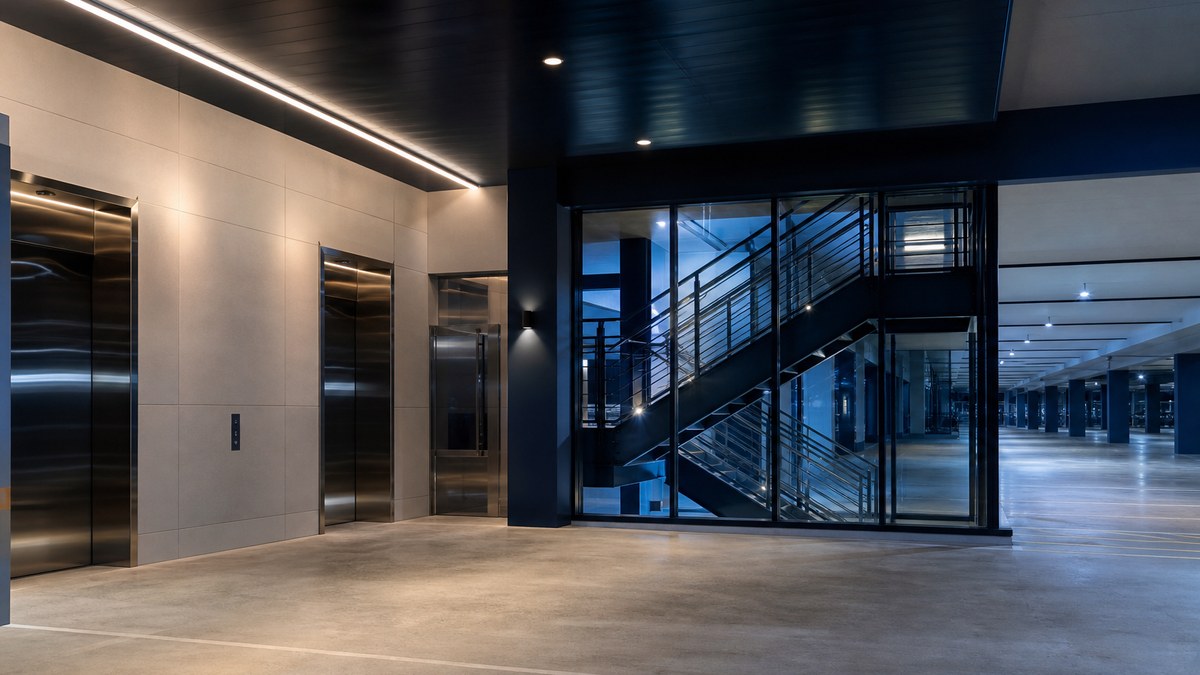
These are the pedestrian gateways. They should feel bright, clean, and welcoming, with good vertical light so people can see faces as they approach. Many properties use a slightly warmer, more architectural look here to match the building lobby. Stairs are also part of the egress path, so normal and emergency lighting must both be coordinated with code requirements.
Roof level
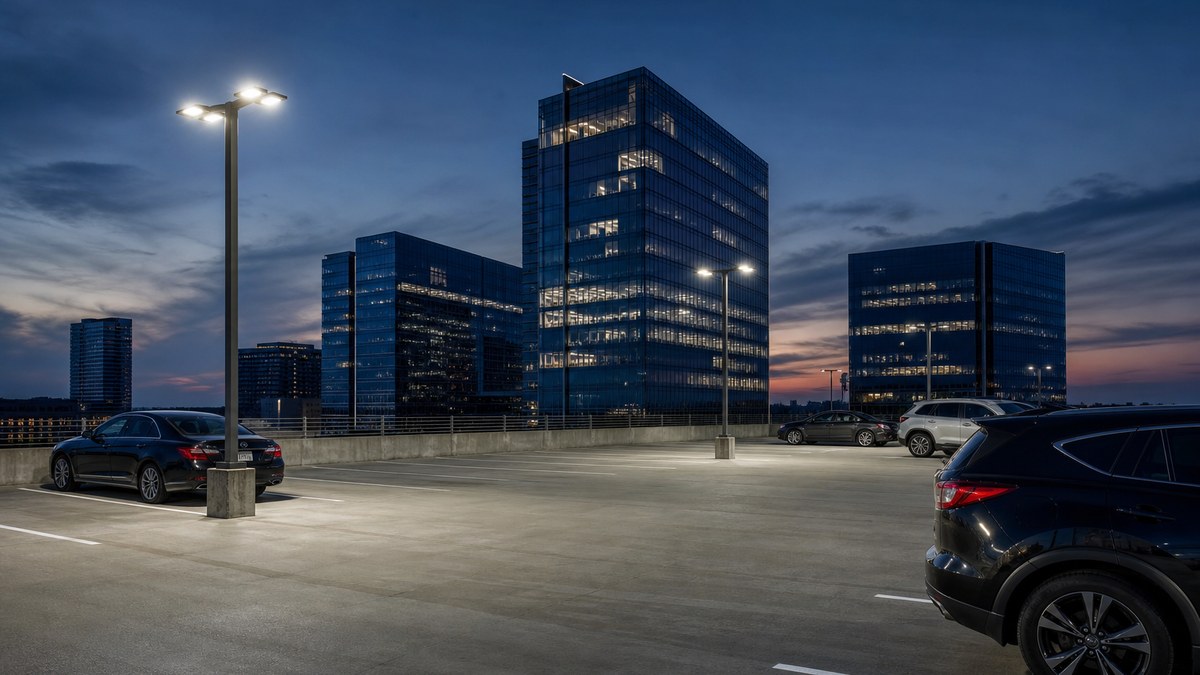
The top deck is an outdoor parking lot sitting on a structure. It typically uses pole-mounted area lights or wall packs on stair and elevator towers, with full cutoff optics to control glare and light trespass toward neighbors. Roof fixtures must handle sun, wind, rain, and hail, and the poles and bases must be coordinated with the structural engineer.
Perimeter and open sides
Many Texas garages are open-sided. Fixtures near those openings receive meaningful daylight during the day, which creates an opportunity for daylight-responsive dimming. The same openings also allow light to spill out at night, so aiming and shielding matter for neighboring properties and roadways.
Parking garage fixture types at a glance
| Fixture | Typical use | What to look for |
|---|---|---|
| LED garage canopy fixture | Covered decks, drive aisles, stalls | Low profile, wide distribution, sealed housing, integrated sensor option |
| Linear LED garage fixture | Long aisles, low ceilings, retrofits of strip fixtures | Vapor-tight or wet-location rating, impact-resistant lens, even output |
| Retrofit kit | Reusing existing housings where condition allows | Listed for the specific fixture, proper heat management, sensor compatibility |
| Wall pack | Perimeter walls, stair tower exteriors, roof level | Full cutoff optics, surge protection, durable finish |
| Pole-mounted area light | Roof deck | Full cutoff, correct distribution type, wind-rated pole and base coordination |
| Architectural downlight or linear | Elevator lobbies, stair towers, entries | Low glare, good color rendering, a finish that matches the building |
| Emergency-capable fixtures | Egress paths, stairs, exits | Battery or central-inverter backup coordinated with the egress lighting plan |
| Exit and wayfinding signage | Exits, levels, pedestrian routes | Clear visibility, LED efficiency, coordination with level and stall signage |
Design principles for a better garage
- Uniformity beats brightness. A garage with moderate, even light feels safer than one with bright spots and deep shadows. The eye adjusts to the bright spots and then cannot see into the dark ones.
- Think vertical as well as horizontal. Light on the floor helps drivers, but light on vertical surfaces, including faces, vehicle sides, and columns, is what makes people recognizable and spaces feel secure.
- Control glare. With low ceilings, fixtures sit close to a driver's line of sight. Low-glare optics and careful placement around ramps keep fixtures from blinding drivers.
- Brighten the surfaces. Painting ceilings and upper walls a light color reflects more light back into the space and improves uniformity. It is one of the most effective upgrades in an older concrete garage.
- Choose color deliberately. Neutral to cool-neutral white with good color rendering helps cameras and makes vehicle colors recognizable. Lobbies can be warmer to match the building.
- Plan the entrance transition. Daytime entrance lighting should step down gradually so drivers are not suddenly in the dark.
- Coordinate signage and wayfinding. Level markers, stall numbers, and exit routes should be well lit and easy to read.
Walk the garage at night and again at midday before designing anything. At night, look for dark pockets between columns and around stair cores. At midday, drive in from the street and notice how long your eyes take to adjust. Those two walks tell you most of what the new design needs to fix.
Lighting for security and cameras
Security is one of the main reasons owners upgrade garage lighting. Older systems with failed lamps, yellowed lenses, and uneven spacing leave dark areas that feel unsafe and that cameras cannot see into. A security-focused lighting design looks at:
- Vertical light at face height along pedestrian routes, at stair and elevator entries, and at pay stations, so people and cameras can see faces.
- Coverage at camera locations so each camera has enough consistent light across its field of view, without fixtures shining directly into the lens.
- Consistent color and output across the garage, which helps camera exposure stay stable as vehicles and people move between areas.
- No dark corners at stairwells, behind columns, at dead-end aisles, or around mechanical rooms.
- Sensor behavior that never drops pedestrian areas into darkness. Occupancy dimming should reduce levels, not switch the garage off, so cameras and people still have usable light.
Lighting works best as part of a broader security plan, alongside cameras, emergency call stations, access control, and regular patrols. We coordinate the lighting layout with your security consultant or integrator so the two systems support each other.
Controls: the biggest opportunity in a garage
Because many garages light every fixture all day and all night, controls are where much of the improvement comes from. Even very efficient LED fixtures waste energy if they run at full output in an empty deck at 3 AM. Modern garage control strategies include:
- Integrated occupancy sensors in each fixture or group of fixtures, which raise output when a vehicle or person is detected and drop to a lower level when the area is empty.
- Daylight-responsive dimming for fixtures near open sides of the structure, which reduces output when daylight is strong enough.
- Entrance zone scheduling that keeps transition lighting bright during the day and reduces it after sunset.
- Astronomical time clocks for the roof level and exterior fixtures, following sunset and sunrise through the seasons.
- Networked lighting controls that let a building engineer adjust levels, set schedules, and see fixture status from one place, sometimes integrated with the building automation system.
- High-end trim and tuning that sets maximum output at what the space actually needs instead of the fixture's full capacity.
For a deeper look at control platforms, protocols, and sensors, read our guide to commercial lighting control systems in Irving.
Make your garage brighter and safer
Tell us about your parking structure and we will follow up to schedule a site walk and prepare a project-specific proposal.
Energy code requirements for parking garages
Energy codes now treat parking garages as their own category for lighting controls. The 2021 International Energy Conservation Code (IECC), for example, includes a dedicated parking garage lighting control section (C405.2.8). As summarized in code training materials, it calls for occupant sensing controls that reduce lighting power by at least 30 percent within 20 minutes of no activity in a zone, with an exclusion for zones that are already very dimly lit at full output; daylight-responsive controls for lighting near perimeter wall openings that admit daylight; and separately controlled eye adaptation (entrance) zones that reduce power by at least 50 percent from sunset to sunrise.
Which edition applies to your project depends on the jurisdiction and the date of your permit. The State of Texas uses the 2015 IECC as its statewide commercial energy code baseline, and cities can adopt newer editions locally. In early 2026, the City of Irving published a proposed ordinance to adopt the 2024 International Codes, including the IECC, with local amendments. Before a major garage project, confirm the code edition and any local amendments in force with the City of Irving's building inspection staff. A full replacement or alteration of lighting can trigger control requirements, while a simple like-for-like repair usually does not, so it is worth settling this early.
Beyond energy codes, parking garages must also meet building and fire code requirements for means of egress and emergency lighting, and the IES (Illuminating Engineering Society) publishes recommended practices for parking facility lighting covering illuminance, uniformity, vertical light, and entrance adaptation. We design to the applicable code and the relevant recommended practice for each project, and we coordinate with your engineer of record where one is involved.
North Texas conditions that affect garage lighting
| Condition | What to specify |
|---|---|
| Summer heat on upper decks | Fixtures and drivers rated for high ambient temperatures, good heat sinking |
| Wind-driven rain on open sides | Wet-location rating where exposed, sealed housings and connections |
| Storms and lightning | Surge protection at fixtures and panels, especially on the roof level |
| Hail on the roof deck | Robust housings and lenses, protected sensor heads |
| Dust, exhaust, and grime | Sealed optics and lenses that are easy to clean |
| Vehicle impacts and vandalism | Impact-resistant lenses, tamper-resistant hardware, protected placement on ramps |
| Concrete structure | Mounting and conduit plans coordinated with post-tensioned slabs and existing penetrations |
Post-tensioned concrete deserves special mention. Many parking structures use post-tensioned slabs, and drilling into them without scanning first can damage tendons. Any new mounting points or conduit routes should be planned with that in mind, which is another reason to reuse existing mounting locations and boxes wherever the layout allows.
Retrofit or redesign: which path fits your garage?
There are two broad ways to upgrade a parking garage, and many projects combine them.
One-for-one LED replacement
New LED fixtures go into the existing locations, using existing boxes and circuits. This is the fastest and least disruptive path, and it works well when the original layout was reasonable and the main problems are age, failures, and energy use. Choosing fixtures with integrated sensors turns a simple replacement into a controls upgrade at the same time.
Layout redesign
When the garage has persistent dark areas, poor uniformity, problems at entrances, or new security requirements, a lighting layout study is the better starting point. Photometric modeling shows how light will land on floors and vertical surfaces before anything is installed. Sometimes the answer is a few added fixtures in key places. Sometimes it is a complete new layout with a different fixture type.
Retrofit kits
Retrofit kits can reuse sound existing housings, which limits waste and work at height. They make sense when the housings are in good condition and the kit is listed for that fixture. In older garages where housings are corroded or lenses are failing, complete new fixtures are usually the more durable choice.
If budget is the main concern, our article on affordable commercial LED lighting upgrades in Irving explains how to phase work and prioritize the areas that matter most. Every project is quoted individually after a site review; we do not publish price lists because garages vary so widely.
Phasing work in an operating garage
Most garages cannot close for an upgrade. Tenants, hotel guests, and visitors still need to park every day. A practical installation plan typically includes:
- Level-by-level or bay-by-bay phasing so most of the garage stays open while one area is coned off.
- Night and weekend work for busy office garages, and coordination with event schedules for hotel and entertainment properties.
- Temporary lighting where needed so no area goes dark during the changeover.
- Clear signage and communication with tenants and parking operators about closures and detours.
- Lift and clearance planning for low ceilings, ramps, and height restrictions.
Incentives and energy savings
Converting a garage to LED with sensors and controls typically reduces lighting energy use substantially compared with older lamp-based systems, and it removes most of the routine lamp and ballast replacement that older garages require. Actual savings depend on the existing system, operating hours, control settings, and utility rates, so we evaluate them for each project rather than quote a rule of thumb. Some Irving projects may qualify for energy efficiency incentives through Oncor, depending on program availability and project details at the time of the upgrade. We can help you check what may apply before work begins.
Common parking garage lighting mistakes
- Over-lighting the aisle center. Bright aisles with dark stalls look fine in a photo but leave people walking to their cars in shadow.
- Ignoring the entrance. A garage that is bright inside but has no daytime transition zone still feels like a dark tunnel to arriving drivers.
- Sensors that switch fully off. A garage that goes dark until someone walks in feels unsafe and hurts camera footage.
- Glare on ramps. Fixtures mounted where drivers look directly into them on a ramp are a safety problem.
- Mixed color temperatures. Patchwork replacements over the years leave some fixtures yellow and others blue, which looks neglected.
- Forgetting emergency lighting. Egress paths, stairs, and exits must still meet emergency lighting requirements after the upgrade.
- Skipping commissioning. Sensors and schedules left at factory defaults rarely match how the garage is actually used.
How a garage lighting project runs
- Site walk. Day and night walkthroughs, fixture counts and conditions, circuits, ceiling heights, camera locations, and problem areas.
- Goals. Safety, security, energy, appearance, code compliance, and how the garage is used across the day.
- Layout and photometrics. Fixture selection, placement, and modeling of horizontal and vertical light where a redesign is needed.
- Controls plan. Sensor zones, daylight zones, entrance schedules, and networked control options.
- Proposal. A clear scope and a project-specific quote, with phasing options.
- Installation. Phased by level or bay, coordinated with your parking operator and tenants.
- Commissioning. Sensor timing and levels, daylight settings, schedules, and emergency lighting verification.
- Ongoing service. Periodic checks, cleaning, settings adjustments, and support as the garage's use changes.
Parking garage lighting for different property types
Class A office towers
Tenant garages are part of the leasing experience. Bright, uniform decks, polished elevator lobbies, and a smooth entrance transition support the premium positioning described in our guide to Class A office lighting upgrades in Irving.
Hotels and convention properties
Guests often arrive tired and unfamiliar with the building, sometimes late at night. Clear wayfinding, welcoming elevator lobbies, and consistent light from car to door matter. See our guide to hotel lighting in Irving and Las Colinas for the rest of the property.
Entertainment and mixed-use districts
Event traffic brings sudden peaks of cars and pedestrians. Controls should bring the garage to full output quickly at event times, then settle back down afterward.
Corporate campuses and data-heavy facilities
Campuses along the DFW Airport corridor often run around the clock with shift changes in the middle of the night. Security lighting and camera coverage are priorities, as covered in our data center lighting guide and our warehouse and logistics lighting guide.
Medical, multifamily, and retail
Medical office garages need gentle, glare-free light for patients and visitors. Multifamily garages are effectively residents' front doors. Retail garages benefit from bright, inviting lighting that encourages evening visits.
Why work with Irving LED Lights
We design, supply, install, program, and service commercial lighting across Irving, Las Colinas, Valley Ranch, and the DFW Airport corridor, including parking structures, surface lots, facades, landscapes, and building interiors, so the whole property works together. Our team brings 15+ years as an authorized architectural lighting dealer and project coordinator. Our licensed installation partner has completed over 200 major sports and commercial projects across the US and Canada — NFL, NBA, NHL, MLS, NCAA and NASCAR. Learn more about us, explore our commercial lighting services, see our service and maintenance support, or look at the Luminance design-build program for complete property lighting transformations. You can also browse our services overview, check the areas we serve, and read our Las Colinas commercial LED lighting guide.
Frequently Asked Questions
What is the best lighting for a parking garage?
How much does a parking garage LED upgrade cost in Irving?
Do parking garages need occupancy sensors?
Why is the entrance of a parking garage lit brighter during the day?
Will motion sensors make our garage feel dark or unsafe?
What color temperature is best for parking garage lighting?
Can we keep the garage open during the upgrade?
Should we use retrofit kits or new fixtures?
Are there incentives for parking garage LED upgrades?
What areas do you serve?
Let's light your parking structure
Request a garage assessment and we will follow up to schedule a day and night site walk.
Related
Planning a bigger refresh? Pair the garage with LED video walls in the lobby or new LED signage and wayfinding, and read more on our lighting blog.
Our DFW lighting network: Dallas commercial LED lighting, Fort Worth LED lighting, Arlington LED lighting, Plano LED lighting, statewide Texas LED lighting, wholesale LED components, fiber optic starlight ceilings, 360° fiber optic lighting, American LED signage, modular building solutions, and Dallas modular structures.