Warehouse & Logistics Lighting in Irving, TX: LED High Bays, Controls & Loading Docks Near DFW Airport
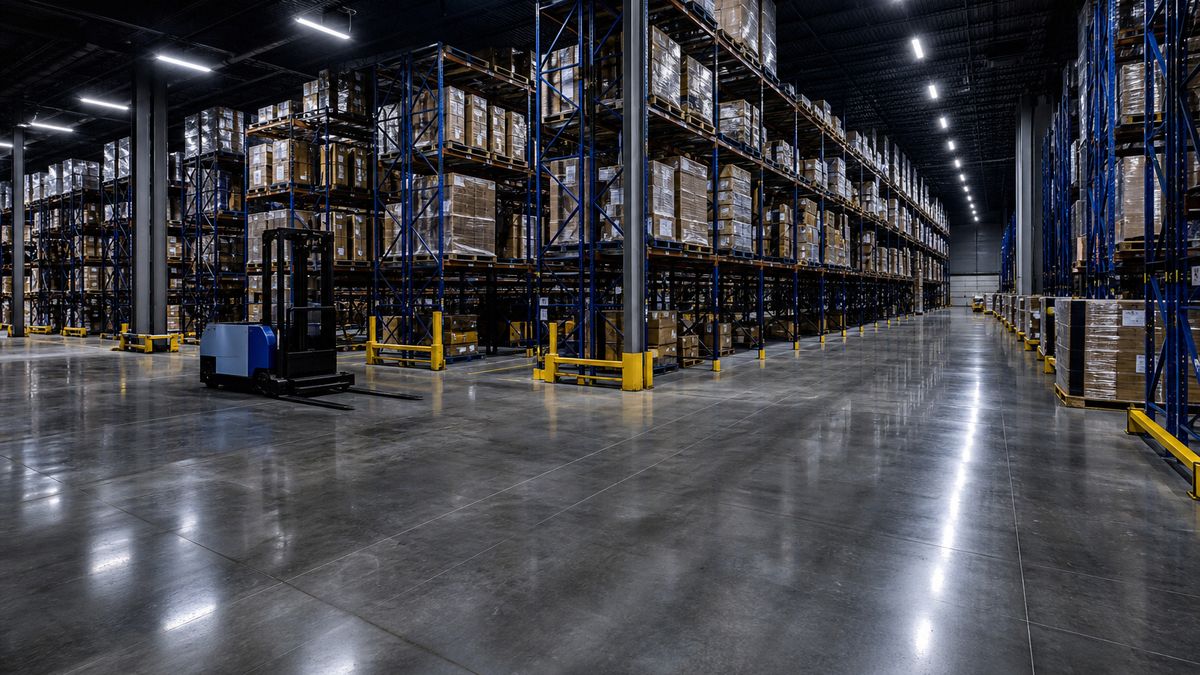
Warehouse lighting in Irving has a direct effect on how safely and how quickly goods move through a building. The DFW Airport corridor, the industrial parks along State Highway 114 and 161, and the logistics buildings south of Las Colinas run around the clock, and the lighting inside them has to keep up: clear visibility down tall racking aisles, accurate picking and label reading, safe forklift traffic, bright and glare-free loading docks, and secure yards and parking after dark.
This guide explains how modern LED lighting works in warehouses, distribution centers, cross-dock facilities, cold storage, and light manufacturing spaces in Irving and the surrounding DFW area. It covers fixture types, aisle and open-floor layouts, controls and sensors, energy-code considerations, loading docks and exterior areas, retrofit versus new construction, and how to plan a project with minimal disruption to operations. It is written for facility managers, operations leaders, property owners, developers, and tenant-improvement teams.
The best warehouse lighting in Irving combines LED high bays matched to ceiling height and racking layout with occupancy sensors, daylight controls, and well-lit docks and yards.
- High bays and linear high bays: the core fixtures for tall clear-height buildings
- Aisle optics: narrow distributions that put light on rack faces, not rack tops
- Sensors and controls: occupancy dimming by aisle, daylight harvesting near skylights and clerestories
- Loading docks: dock lights for trailer interiors plus bright, even apron lighting
- Exterior and yard: full-cutoff area lights and wall packs for trucks, parking, and security
- Built for North Texas: heat-rated drivers, surge protection, sealed fixtures where needed
- Pricing: quoted per facility after a site review and lighting layout
Why warehouse lighting matters more than ever
Warehouse lighting used to be an afterthought: a grid of metal halide or fluorescent fixtures that stayed on all shift and slowly dimmed between relamps. Today's logistics operations demand more. Faster pick rates, scanning, tighter aisles, taller racking, mixed human and automated traffic, and multi-shift schedules all depend on good light. The benefits of getting it right include:
- Safety: clear sightlines at aisle ends, intersections, and docks help operators and pedestrians see each other.
- Accuracy: even vertical light on rack faces makes labels, barcodes, and SKUs easier to read, which reduces picking errors.
- Productivity: workers move with confidence when there are no dark spots or harsh glare.
- Energy and maintenance: LED fixtures with controls use far less energy than older technologies and last much longer, so lifts and relamping become rare.
- Tenant appeal: for owners and developers, modern lighting and controls are part of what makes a building competitive in a busy industrial market.
- Security: well-lit yards, perimeters, and parking support cameras and deter theft.
Energy savings from LED lighting and controls vary by facility, hours of operation, and existing equipment, so we evaluate each building individually rather than promising a number.
Understanding your space before choosing fixtures
No two warehouses are the same. A good lighting design starts with how the building is actually used. Before we recommend a fixture, we look at:
- Clear height and mounting height of the fixtures, which drives optics and fixture output.
- Racking layout: aisle widths, rack heights, and whether the layout is likely to change.
- Open areas: staging, cross-dock lanes, kitting, packing, and shipping zones.
- Tasks: bulk storage, case picking, each picking, packing, inspection, and quality control all need different light levels.
- Shifts and occupancy: which zones run around the clock and which sit empty for long periods.
- Daylight: skylights, clerestory windows, and dock doors that bring in natural light.
- Environment: conditioned or unconditioned space, cold storage, dust, washdown, or high-heat roof areas.
- Existing electrical: circuits, voltage, panel capacity, and any existing control system.
Target light levels are based on IES (Illuminating Engineering Society) recommendations for each task and space type. We then verify the design with a photometric layout so you can see predicted light levels and uniformity before anything is installed.
Fixture types for warehouses and distribution centers
Round (UFO) LED high bays
Compact, powerful fixtures suited to open floors and high ceilings. They are quick to install and work well in bulk storage and open staging areas, especially with wide or medium beam optics.
Linear LED high bays
Long, narrow fixtures that are the workhorse of most modern warehouses. Linear high bays with aisle optics run parallel to racking and push light down the aisle and onto the rack faces. They are also easy to fit with integrated sensors.
Low bays and strip lights
For mezzanines, lower-ceiling areas, packing lines, and support spaces, low bays and LED strips give even light without overpowering the space.
Vapor-tight and enclosed fixtures
Cold storage, freezers, washdown areas, and dusty zones need sealed fixtures that resist moisture, condensation, and contaminants, with drivers rated for the temperature range.
Dock lights and dock area fixtures
Articulating dock lights put light inside trailers for loading and unloading, while high-output fixtures above the dock apron keep the transition area bright.
Exterior area lights and wall packs
Full-cutoff area lights on poles and wall packs on the building light truck courts, trailer parking, employee parking, and perimeters.
| Area | Typical fixture | Design focus |
|---|---|---|
| Racking aisles | Linear high bays with aisle optics | Vertical light on rack faces, uniformity down the aisle |
| Open storage / staging | Round or linear high bays, wide optics | Even horizontal light, low glare |
| Packing and kitting | Linear high bays or low bays | Higher task light, good color rendering |
| Mezzanines | Low bays, strips | Even light without glare at lower heights |
| Cold storage | Sealed, cold-rated fixtures | Moisture resistance, instant-on in low temperatures |
| Loading docks | Dock lights plus apron high bays | Trailer interiors, safe transitions from outside light |
| Truck courts and parking | Area lights, wall packs | Even coverage, full cutoff, camera support |
| Offices and break rooms | Troffers, panels, downlights | Comfort, daylight and occupancy controls |
Lighting racking aisles the right way
Aisles are where most warehouse lighting either succeeds or fails. The goal is not just bright floors but light on the vertical faces of the racks, from the bottom beam to the top, so labels and product are easy to see at every level.
- Mount fixtures over the aisle centerline, not over the racks, so light is not blocked by product.
- Use aisle or narrow optics that throw light along and down the aisle instead of spilling onto rack tops.
- Balance uniformity. Spacing fixtures correctly avoids bright pools and dark gaps between them.
- Watch the ends of aisles. Intersections and cross aisles need extra attention for forklift and pedestrian safety.
- Plan for re-racking. Flexible mounting, cord-and-plug connections, or chain-hung linear fixtures make it easier to move lights when the layout changes.
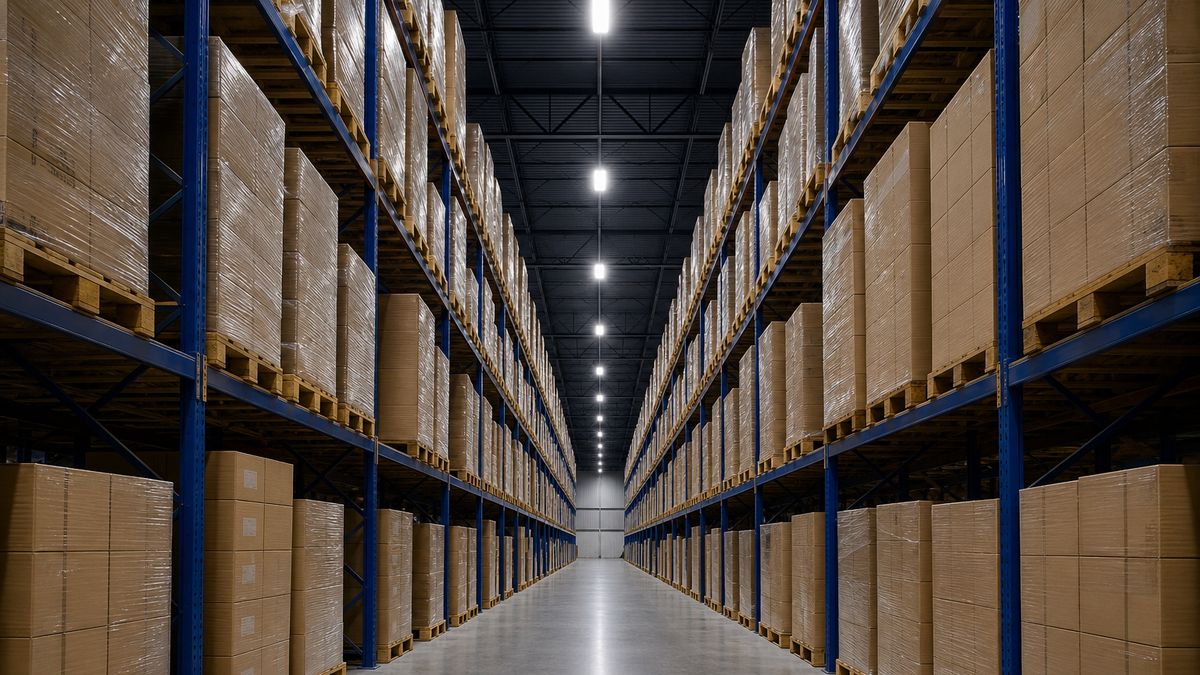
Ask for a photometric study that shows vertical light on the rack faces, not just average floor light. Two layouts with the same floor numbers can look very different when an operator is trying to read a label on the top beam.
Controls and sensors: where the real savings live
Switching to LED is only half the story. In many warehouses, aisles sit empty for long stretches, and controls let lights dim or turn off when nobody is there and come back to full output instantly when someone arrives. Common strategies include:
- Occupancy sensors per fixture or per aisle: lights dim to a low level when an aisle is empty and return to full when a forklift or picker enters.
- High-end trim: setting maximum output to the level the space actually needs, rather than full power everywhere.
- Daylight harvesting: dimming fixtures near skylights, clerestories, and open dock doors when daylight is strong.
- Scheduling: time-based control that follows shift patterns and weekends.
- Zoning: separate zones for aisles, staging, docks, offices, and exterior lighting.
- Networked lighting control: wireless or wired systems that let facility teams adjust settings, see status, and in some systems report energy use from a dashboard.
Because LED fixtures turn on instantly with no warm-up, they are a natural fit for occupancy control in a way that older metal halide fixtures never were. For a deeper look at control protocols such as DALI, 0-10V, and networked systems, see our guide to commercial lighting control systems in Irving.
Energy code and permitting considerations
New construction, additions, and many lighting alterations in Texas fall under the commercial energy code adopted by the local jurisdiction. Current versions of the code generally call for automatic shutoff or occupancy-based controls, daylight-responsive controls in qualifying daylight zones, and limits on lighting power. Requirements depend on the code edition the City of Irving or your local jurisdiction has adopted and on the scope of the project.
Our approach is to identify the applicable requirements early, design the lighting and controls to meet them, and coordinate with your electrical contractor, architect, or engineer on permitting. That avoids redesign late in a project and keeps inspections smooth.
Loading docks: the most demanding zone
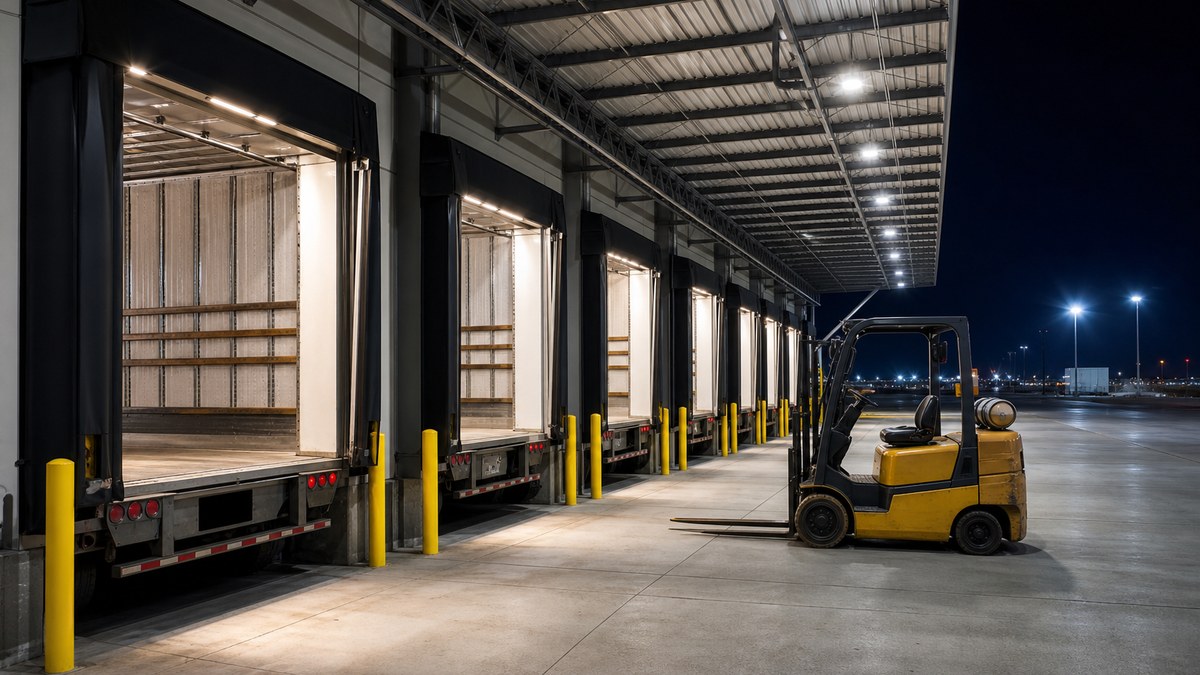
Docks see the most traffic, the most equipment movement, and the biggest swings in light level, from bright Texas sun outside to the dim interior of a trailer. Good dock lighting includes:
- Dock lights on articulating arms that put light deep into trailers.
- Bright, even apron lighting inside the dock doors so operators are not moving from glare into shadow.
- Exterior lighting above doors for drivers backing in at night.
- Sensors and zoning so unused doors can dim while active doors stay bright.
- Durable fixtures that stand up to vibration, dust, and occasional impacts.
Get a lighting plan for your facility
Tell us about your building, racking, and shifts, and we will follow up with recommendations and a project-specific proposal.
Exterior, yard and parking lighting
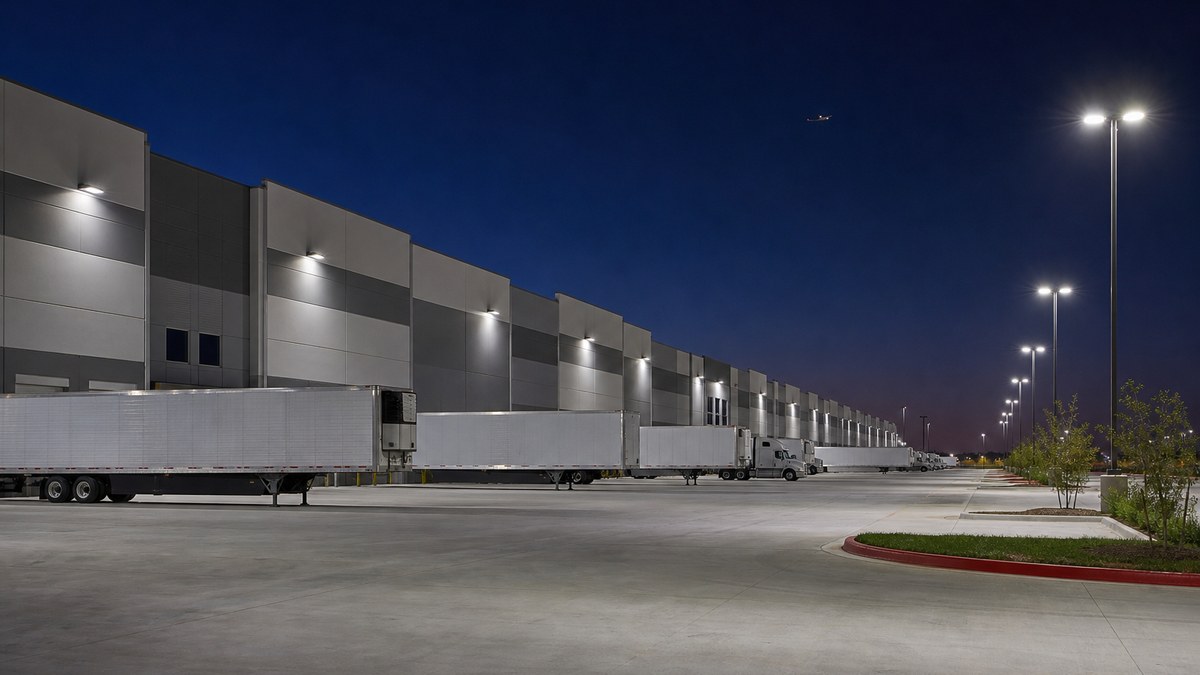
A logistics facility does not stop at the dock door. Truck courts, trailer parking, employee parking, gates, and building perimeters all need lighting that supports safe driving, walking, and security cameras. LED area lights and wall packs with full-cutoff optics put light on the ground instead of into the sky or into neighboring properties, and photocells and scheduled dimming keep energy use in check overnight.
For multi-building campuses and properties near residential areas, careful aiming and shielding matter. See our guide to commercial outdoor LED lighting in Irving for more on parking, facade, and site lighting.
Built for North Texas conditions
| Condition | What to specify |
|---|---|
| High roof-level heat in summer | Fixtures and drivers rated for high ambient temperatures, good thermal design |
| Storms and lightning | Surge protection on fixtures and circuits |
| Dust and debris | Sealed or easy-to-clean optics, appropriate ingress protection |
| Cold storage and freezers | Cold-rated fixtures and drivers, moisture and condensation resistance |
| Forklift impacts and vibration | Robust housings, secure mounting, guards where needed |
| Exterior UV and rain | UV-stable lenses and finishes, outdoor-rated, sealed connections |
Retrofit vs new construction
Retrofitting an existing warehouse
Many Irving-area warehouses still run on older metal halide, high-pressure sodium, or fluorescent high bays. Replacing them with LED fixtures is usually the most practical upgrade. A retrofit typically involves a site audit, fixture-by-fixture replacement, adding sensors and controls, and in some cases re-spacing fixtures to fit the current racking layout rather than the original one.
Work can be phased by zone or scheduled around shifts so operations continue. Lifts, aisle closures, and staging are planned in advance with your operations team.
New construction and tenant improvements
For new buildings and new tenants, lighting is designed alongside the racking plan, sprinkler layout, and electrical design. Coordinating early avoids conflicts between fixtures, sprinkler heads, and rack locations and makes sure controls and daylight zones are in place from day one. Speculative buildings can be lit with a flexible layout that suits a range of future tenants.
Utility incentives and energy savings
LED upgrades with controls typically reduce lighting energy use and maintenance compared with older technologies, but actual results depend on your current fixtures, hours of operation, and how controls are set. Some projects in the Oncor service area may qualify for energy-efficiency incentive programs, depending on program availability and eligibility at the time of the project. We can help you understand what may apply and the documentation that programs usually require. For more ways to stretch a lighting budget, see our guide to affordable commercial LED lighting upgrades in Irving.
Color, glare and visual comfort
Light quality matters as much as quantity in a working warehouse:
- Color temperature: neutral to cool white is common in warehouses because it feels bright and alert; offices and break rooms often use warmer tones.
- Color rendering: good color rendering helps with color-coded labels, packaging, and quality inspection.
- Glare control: lenses, diffusers, and proper mounting keep operators who look up at high racks from being blinded.
- Flicker: quality drivers reduce flicker, which matters for comfort and for camera and scanning systems.
Planning a warehouse lighting project
- Site walk and audit. We document existing fixtures, mounting heights, racking, circuits, and how each zone is used.
- Goals. Safety, accuracy, energy, maintenance, code compliance, and tenant appeal are prioritized with your team.
- Lighting layout. Fixture selection, optics, spacing, and a photometric study for aisles, open areas, and docks.
- Controls design. Sensors, zones, daylight areas, schedules, and any networked control.
- Proposal. A clear scope and project-specific price.
- Scheduling. Phasing around shifts, peak seasons, and dock schedules.
- Installation. Lifts, aisle closures, and safety protocols coordinated with operations.
- Programming and commissioning. Sensor timeouts, dim levels, daylight settings, and schedules tuned to how the building runs.
- Support. Adjustments after go-live, plus service when layouts or operations change.
Common warehouse lighting mistakes
- Choosing fixtures by wattage alone. Optics and placement matter more than raw output.
- Lighting rack tops instead of aisles. Fixtures over racks waste light and leave aisles dim.
- Skipping controls. LED without sensors leaves a large share of the possible savings unused.
- Sensor timeouts set too short. Lights that dim while people are still working frustrate staff and lead to sensors being disabled.
- Ignoring the docks. Docks often need special attention, not just more high bays.
- No plan for layout changes. Fixed fixture positions become a problem when racking moves.
- Forgetting exterior lighting. Truck courts and parking lots are part of the same safety picture.
Facility types we light
Distribution and fulfillment centers
High-throughput buildings with tall racking, conveyors, and multi-shift operations where aisle lighting and controls make the biggest difference.
Cross-dock and freight facilities
Dock-heavy buildings near DFW Airport and the major highways where dock and yard lighting are as important as interior lighting.
Cold storage
Coolers and freezers that need sealed, cold-rated fixtures and controls that perform reliably in low temperatures.
Light manufacturing and flex space
Mixed-use buildings with production, assembly, storage, and office areas under one roof, each with its own lighting needs.
Showrooms and office areas in industrial buildings
Front offices, break rooms, and showrooms that benefit from the same quality of lighting as a Class A office. Our commercial lighting services cover these spaces too.
Why work with Irving LED Lights
We design, supply, install, program, and service commercial lighting for Irving, Las Colinas, Valley Ranch, Coppell, Grapevine, and the DFW Airport corridor, including warehouses, offices, hotels, and exterior sites, so a whole property can be handled by one team. We bring 15+ years as an authorized architectural lighting dealer and project coordinator. Our licensed installation partner has completed over 200 major sports and commercial projects across the US and Canada — NFL, NBA, NHL, MLS, NCAA and NASCAR. Learn more about us, see our full range of commercial lighting services, or explore Luminance design-build for complete lighting transformations. If your facility also has a lobby or training room that needs a display, our guide to LED video walls in Irving covers that as well.
Frequently Asked Questions
What is the best lighting for a warehouse in Irving, TX?
How much does warehouse LED lighting cost in Irving?
How many lumens or how much light does a warehouse need?
Should warehouse high bays have motion sensors?
What is the difference between UFO and linear high bays?
Can you upgrade warehouse lighting without shutting down operations?
What lighting works in cold storage and freezers?
Are there utility incentives for warehouse LED upgrades?
Do you light loading docks and truck courts?
What areas do you serve?
Let's light your warehouse
Request a consultation and we will follow up to schedule a site walk of your facility.
Related
Our DFW lighting network: Dallas commercial LED lighting, Fort Worth LED lighting, Arlington LED lighting, Plano LED lighting, statewide Texas LED lighting, wholesale LED components, fiber optic starlight ceilings, 360° fiber optic lighting, LED signage, modular building solutions, and Dallas modular structures for on-site offices and yard buildings.