Hotel Lighting in Irving & Las Colinas, TX: Lobbies, Guest Rooms, Ballrooms & Exteriors
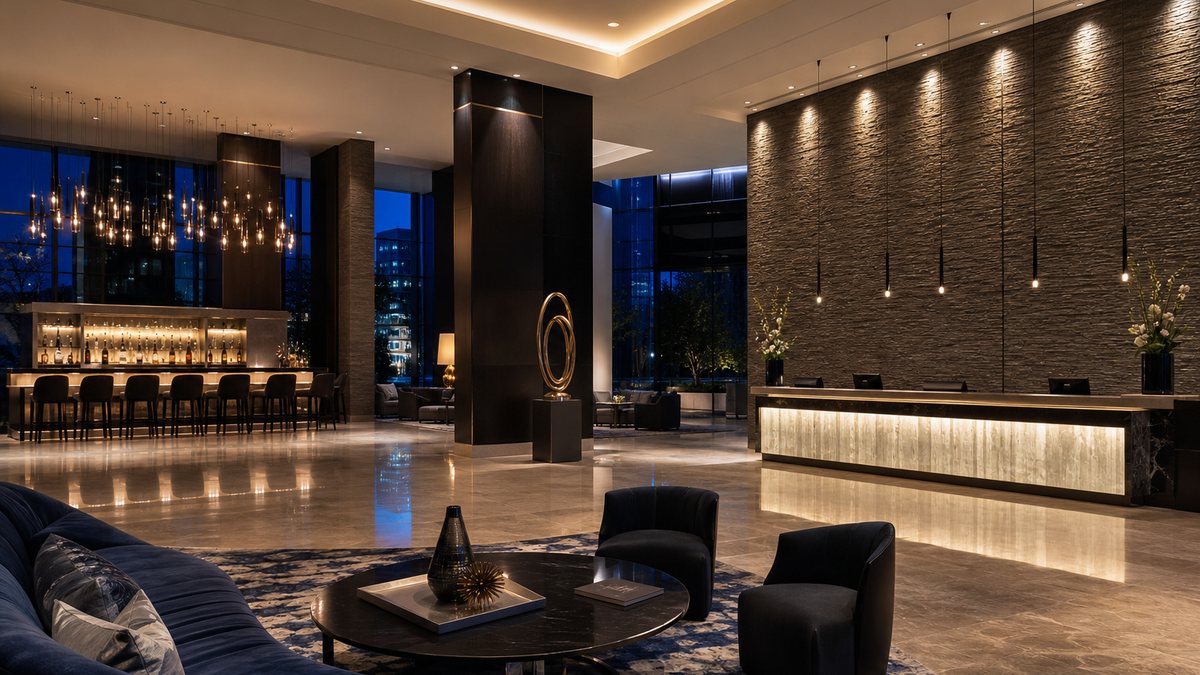
Hotel lighting in Irving has to work harder than lighting in almost any other building type. A single property near the Irving Convention Center, the Urban Center in Las Colinas, or the DFW Airport corridor might host a business traveler checking in at midnight, a wedding in the ballroom, a regional sales meeting in the breakout rooms, and families relaxing by the pool, all on the same day. Every one of those guests forms an impression of the hotel partly through light: how the arrival court looks from the street, how the lobby feels at check-in, whether the guest room is easy to use, and whether the event space looks great in photos.
This guide is written for hotel owners, general managers, asset managers, chief engineers, designers, and developers planning a new build, a renovation, or a brand-standard refresh in Irving and Las Colinas. It walks through every major zone of a hotel, from the porte-cochère to the guest room, explains how modern LED fixtures and lighting controls fit together, covers energy-code considerations, and lays out a practical plan for upgrading an operating property without disrupting guests.
Great hotel lighting layers warm, dimmable LED light and smart controls across every zone so the property looks welcoming, works efficiently, and adapts from daytime to evening events.
- Exterior and arrival: facade, porte-cochère, signage and parking lighting that guide guests in safely
- Lobby and public areas: layered ambient, accent and decorative light with time-of-day scenes
- Guest rooms: intuitive switching, bedside and bathroom lighting, and automatic occupancy-based shutoff
- Ballrooms and meeting rooms: fully dimmable, flicker-free light with presets for every event type
- Restaurants, bars and pool decks: mood lighting that keeps guests on property longer
- Back of house: efficient, sensor-controlled lighting for corridors, kitchens, laundry and garages
- Pricing: quoted per property after a walkthrough and lighting review
Why lighting matters more in hotels
In an office, lighting mostly needs to support work. In a hotel, lighting is part of the product being sold. It shapes guest perception, drives reviews and photos, supports brand standards, and runs around the clock. A few reasons it deserves attention:
- First impressions happen outside. Guests judge a hotel from the driveway. A dim, patchy facade or a flickering porte-cochère suggests a tired property before anyone reaches the front desk.
- Lighting runs 24/7. Lobbies, corridors, stairwells, garages and exterior lighting often never turn off, so efficiency and controls have an outsized effect on operating costs.
- Guests share what they see. Lobbies, bars, ballrooms and rooftop spaces end up in social posts and review photos. Good light makes those images work in the hotel's favor.
- Events depend on it. Weddings, galas and corporate meetings need flexible, dimmable light that looks right in person and on camera.
- Brand standards require it. Flagged hotels must meet specific requirements for color, light levels and fixture types during renovations and property improvement plans.
- Comfort and sleep. Guest rooms need light that is easy to control, warm in the evening, and completely dark when the guest wants to sleep.
For Irving properties that compete for convention attendees, corporate travel from Las Colinas office campuses, and airport travelers, lighting is one of the most visible ways to stand out.
Exterior, arrival and porte-cochère lighting
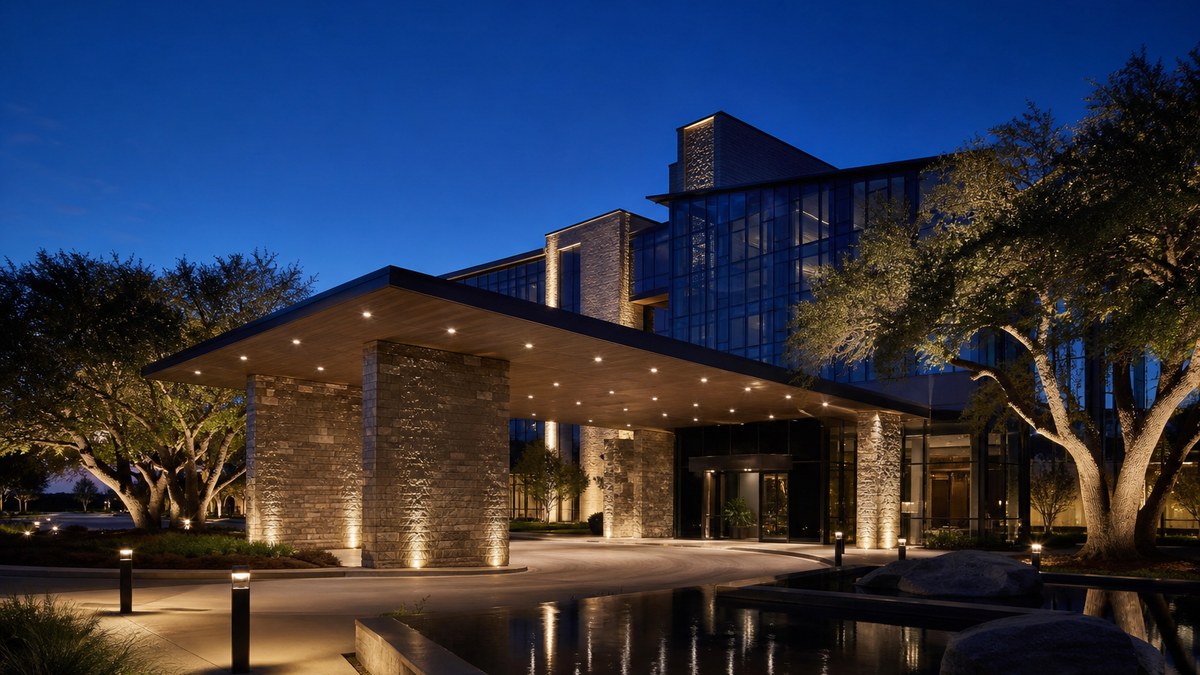
The arrival sequence sets the tone. From the street, the building should read clearly at night, with the entrance obvious and the drop-off area bright, even and inviting.
Facade lighting
Grazing and washing light across the facade gives the building presence after dark. Linear LED grazers can highlight columns and vertical fins, while discreet floodlights wash larger surfaces. Color-capable fixtures let the hotel shift to seasonal or event colors and back to warm white without changing hardware. Our guide to commercial outdoor LED lighting in Irving goes deeper on facade and parking strategies.
Porte-cochère and drop-off
Covered drop-off areas need generous, even light so guests can unload bags safely and valets can work comfortably. Recessed or surface-mounted downlights with good glare control keep the canopy bright without creating hot spots, and warm color temperature keeps it feeling like hospitality rather than a gas station.
Signage and wayfinding
Monument signs, building signs and directional signage should be lit consistently with the rest of the exterior. For digital displays and illuminated signage, see our LED signage services and our network partner for custom LED signage.
Parking lots and garages
Hotel guests park and walk at all hours. Even, well-distributed LED area and garage lighting with motion-based dimming improves safety and supports security cameras while cutting overnight energy use. Shielded optics keep light on the property and out of neighboring windows.
Landscape and grounds
Uplit trees, lit walkways and illuminated water features make the grounds part of the experience, especially at properties near the Las Colinas canals and lakes. Our commercial landscape lighting guide covers techniques and fixtures in detail.
Lobby and public area lighting
The lobby is the hotel's living room, and it is lit for many moods in a single day: bright and energetic for morning check-outs, relaxed through the afternoon, and warm and intimate in the evening when the lobby bar fills up.
Layer the light
- Ambient light: recessed downlights, coves and indirect lighting provide the base level without glare.
- Accent light: adjustable spots highlight artwork, feature walls, plants and architectural details.
- Decorative light: chandeliers, pendants and sconces carry the design story and the brand's personality.
- Task light: the front desk, concierge and business center need focused light that is comfortable for staff and guests.
Time-of-day scenes
A lighting control system with astronomical scheduling can shift the lobby automatically through the day. Light levels rise in the morning, soften through the afternoon and dim warmly in the evening. Some properties also adjust color temperature over the day, cooler in the morning and warmer at night, so the space always feels appropriate. Staff can override scenes from a simple keypad for special events.
Front desk and arrival moments
Faces matter at the front desk. Light that comes from the front and sides, not just straight down, avoids harsh shadows on guests and staff and makes the first conversation feel welcoming. Backlit feature walls or logo walls behind the desk can be a strong brand moment when lit evenly.
Corridors and elevator lobbies
Guest corridors run continuously, so they are a major opportunity for savings. Wall sconces and indirect lighting create a residential feel, while controls can lower light levels when corridors are empty overnight, as long as minimum light levels for safety are maintained. Elevator lobbies on each floor are a good place for a small decorative moment that ties back to the lobby design.
Guest room lighting
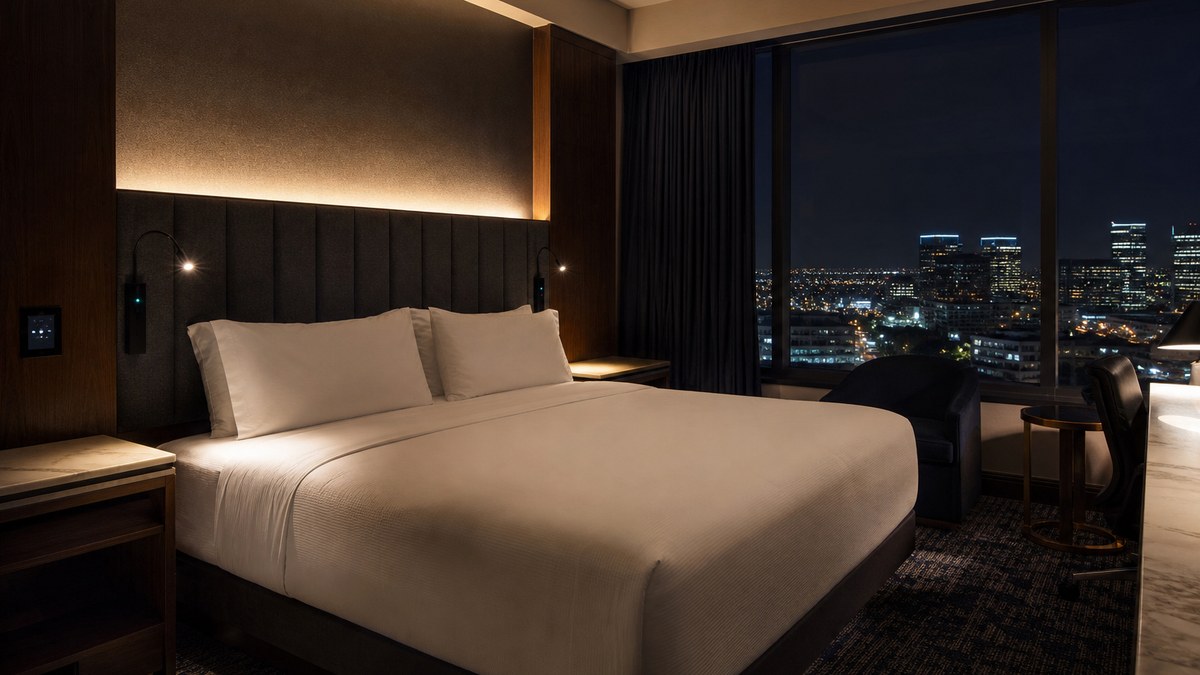
The guest room is where the hotel promise is kept or broken. Guests want light that is easy to understand, comfortable for reading and getting ready, and completely controllable when it is time to sleep. Frustrating switches and lamps that will not turn off are among the most common complaints in hotel reviews, and they are easy to fix with good design.
Design principles for guest rooms
- Intuitive switching. A clearly labeled master switch at the entry and the bedside lets guests turn everything on or off from either place.
- Bedside reading light. Individually controlled reading lights let one guest read while the other sleeps.
- Warm, dimmable light. Around 2700K to 3000K in sleeping areas feels residential and relaxing.
- Good vanity light. Even, front-facing light at the mirror with high color rendering makes grooming easy and flattering.
- Night light. A low-level path light in the bathroom or under the vanity helps guests at night without waking them up fully.
- Easy-to-find controls. Illuminated or clearly marked switches help guests in an unfamiliar room.
- Accessible design. Controls at reachable heights and clear operation support guests of all abilities, and accessible rooms must meet applicable accessibility requirements.
Automatic shutoff and energy codes
Current energy codes such as the IECC and ASHRAE 90.1 generally include requirements for hotel and motel guest rooms to automatically turn off lighting and switched outlets after guests leave the room. This is typically handled with occupancy sensors, keycard systems, or room control systems tied to the property management system. The exact requirement depends on the code edition adopted for the project, so confirm it with the design team and local building officials before finalizing a renovation. For a broader look at control types, see our guide to commercial lighting control systems in Irving.
Room control options
| Approach | How it works | Best fit |
|---|---|---|
| Occupancy / vacancy sensors | Sensors detect when the room is empty and switch off lighting after a set time | Renovations seeking a simple, reliable upgrade |
| Keycard energy switch | Room power to lighting and switched outlets follows the keycard holder at the entry | Select-service and extended-stay properties |
| Networked room controls | Lighting, HVAC and drapes tie to the property management system and know when a room is sold or vacant | Full-service and upscale hotels, new builds |
| Wireless retrofit controls | Battery-free or wireless switches and sensors added without opening walls | Occupied hotels where downtime must be minimal |
Bathrooms
Bathroom lighting must balance function and atmosphere. Bright, even mirror lighting with high color rendering is essential for grooming, while a dim night-light setting avoids blinding a guest at 3 AM. Fixtures in showers and wet locations must be rated for the location, and all work should follow electrical code requirements for damp and wet areas.
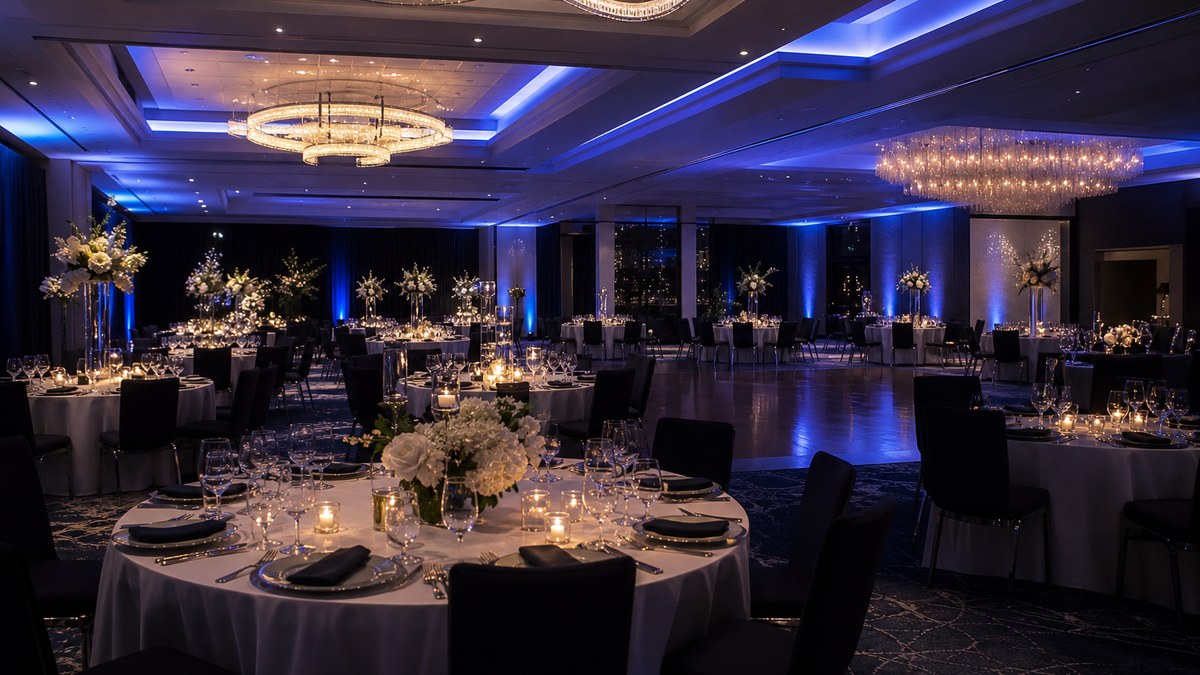
Ballrooms, meeting rooms and event spaces
Event space is a major revenue driver for Irving hotels near the convention center and the Las Colinas corporate campuses. The lighting has to adapt to galas, weddings, keynote presentations, trade shows, breakout sessions and banquets, sometimes in the same room on the same day.
What event spaces need
- Smooth, full-range dimming. Fixtures and drivers that dim smoothly to very low levels without flicker or color shift.
- Camera-friendly light. Flicker-free drivers and high color rendering so livestreams, video and photos look right.
- Presets for every use. One-touch scenes such as "Presentation," "Dinner," "Dance" and "Cleaning" that staff can recall without training.
- Partition awareness. When airwalls divide a ballroom, each section's controls should work independently, then combine when the room opens up.
- Architectural color. Color-capable coves and uplights let planners match event themes and brand colors without bringing in rental equipment for every event.
- Integration with AV. Lighting controls that coordinate with projection, LED video walls and audio systems.
Many hotels now add permanent LED video walls in ballrooms, pre-function areas and meeting rooms instead of relying on projectors. Our guide to LED video walls in Irving explains pixel pitch, viewing distance and installation, and our video wall services cover design through support.
Pre-function and breakout rooms
Pre-function spaces outside ballrooms see heavy traffic during breaks and receptions, so they benefit from the same scene control as the main room. Breakout and boardroom spaces need comfortable, glare-free light for long meetings and video calls, with simple controls at the door and the presenter position.
Planning a renovation or new property?
Tell us about your hotel and we will follow up to schedule a walkthrough and prepare a project-specific proposal.
Restaurants, bars, rooftops and pool decks
Food and beverage outlets and outdoor amenities are where guests linger, and lingering guests spend more. Lighting is one of the most important tools for creating that atmosphere.
Restaurants
Restaurants need light on the table and on faces, with darker surroundings to create intimacy. Tightly focused downlights, pendants over tables, and warm color make food look appealing. Breakfast service may need a brighter scene than dinner, so dimming and scene control matter here too.
Lobby bars and lounges
Backlit bar displays, under-counter linear lighting and low-level ambient light make the bar a destination. Many Irving properties position the lobby bar as a social hub for both guests and locals, and lighting does much of the work in making it feel like a place to stay.
Rooftops, patios and pool decks
Outdoor amenity spaces need lighting that is safe, attractive and built for Texas weather. Low-glare step and path lights keep circulation safe, while uplit plantings and festoon or decorative fixtures create atmosphere. Pool lighting must be specifically rated for the application and installed to code. For amenity pools, our network partner provides premium pool lighting, and 360° laser fiber optic lighting can keep electricity away from water features entirely.
Signature ceilings and feature moments
Spas, bars, suites and lounges sometimes feature a dramatic ceiling or wall that becomes the hotel's signature photo spot. Fiber optic starlight ceilings are one popular option for spas, suites and lounges.
Back-of-house: where the savings hide
Guests never see the back of house, but it is often where the easiest efficiency gains are found. Many of these spaces still use older fluorescent or HID fixtures and run all day.
| Area | Typical upgrade | Control strategy |
|---|---|---|
| Service corridors | LED linear fixtures or retrofit kits | Occupancy sensors with low-level standby |
| Commercial kitchens | Sealed, cleanable LED fixtures rated for the environment | Scheduled on/off aligned with service hours |
| Laundry | Damp-rated LED fixtures with good uniformity | Occupancy and schedule control |
| Storage and housekeeping rooms | Compact LED fixtures | Vacancy sensors so lights never stay on |
| Mechanical and electrical rooms | LED strip or vapor-tight fixtures | Vacancy sensors or timer switches |
| Stairwells | LED stairwell fixtures with integral sensors | Bi-level dimming while maintaining required light levels |
| Parking garages | LED garage fixtures with integral sensors | Motion-based dimming plus daylight control at perimeters |
Emergency and egress lighting should be reviewed as part of any back-of-house upgrade so that battery units, emergency drivers and exit signs are properly integrated and tested. Life-safety lighting must always meet applicable code requirements.
Choosing the right LED fixtures and specs
Not all LED products suit hospitality. These specifications matter most:
- Color temperature: warm white, typically 2700K to 3000K, for guest-facing spaces; tunable white where flexibility is worth it.
- Color rendering: high CRI so skin tones, food, finishes and artwork look natural.
- Color consistency: tight binning so fixtures across the lobby and corridors match.
- Dimming performance: smooth, flicker-free dimming down to low levels, matched to the control protocol.
- Glare control: deep regressed optics, baffles and diffusers so guests see light, not bright points.
- Serviceability: drivers and modules that maintenance teams can access and replace without major disruption.
- Long-term availability: products that can be matched later when a fixture fails or a wing is renovated.
Control protocols
Hotels commonly use 0-10V dimming for general fixtures, DALI for addressable control in larger spaces, phase dimming for decorative fixtures and some retrofits, and DMX for color-capable architectural and event lighting. Networked lighting controls can tie these together, report energy use and allow scheduling from a central dashboard. The right mix depends on the property, its existing wiring and the level of flexibility the operator wants.
Energy, codes and incentives
Because so much hotel lighting runs around the clock, switching to LED and adding controls typically produces meaningful energy and maintenance savings. LEDs also produce less heat than older lamp types, which can reduce cooling load in a hot North Texas climate. Exact savings depend on the existing system, operating hours, and the scope of the upgrade, so we evaluate each property individually rather than quoting generic figures.
Renovations that replace lighting may trigger current energy code requirements for controls and lighting power, so it is important to plan the upgrade with the applicable code in mind. Some lighting upgrades may qualify for utility incentive programs, including those offered through Oncor, depending on program availability and project details. We can help identify programs that may apply during the proposal process.
Before a renovation, ask your chief engineer for a list of the fixtures and lamps your team replaces most often. Those are usually the first places an LED and controls upgrade pays off, and they make a good starting phase if the full project needs to be spread across budgets.
Upgrading an operating hotel without disrupting guests
Most Irving hotels cannot close for a lighting project. A well-planned upgrade keeps rooms sellable and events running:
- Walkthrough and audit. Review every zone, existing fixtures, controls, wiring and brand standards, including a night visit to see the exterior.
- Priorities and phasing. Identify high-impact areas, such as the exterior, lobby and corridors, and group guest-room work by floor or stack.
- Design and specification. Fixture selections, control strategy, scenes and brand-standard compliance.
- Mockups. A sample guest room or lobby section lets ownership and the brand approve the look before full rollout.
- Proposal. A clear scope with a project-specific price.
- Phased installation. Work scheduled around occupancy, with quiet hours respected and rooms returned to inventory quickly.
- Programming and training. Scenes and schedules set up, and staff trained on keypads and overrides.
- Ongoing service. Maintenance support, spare parts planning and adjustments as the property's needs change.
For a full design-build approach that covers concept through installation, see our Luminance design-build program. If budget is the main constraint, our guide to affordable commercial LED lighting upgrades in Irving shows how to phase and prioritize.
Common hotel lighting mistakes
- Mixed color temperatures. Replacing failed lamps one at a time with whatever is in stock leaves lobbies and corridors patchy and inconsistent.
- Confusing guest room switches. Too many unlabeled switches frustrate guests and lead to complaints.
- Dimming that flickers or drops out. Fixtures and controls that are not matched cause flicker, buzzing and lights that will not dim smoothly.
- Over-lit lobbies. Flat, bright light everywhere feels like an office, not a hotel.
- Ignoring the exterior. A great interior does not help if the building disappears at night.
- Event spaces without presets. Staff improvising with dozens of switches leads to inconsistent results at important events.
- No plan for replacements. Choosing products that cannot be matched later creates mismatched fixtures within a few years.
Hotel lighting across Irving and nearby
We support hospitality properties throughout our service area, including Las Colinas and the Urban Center, the Irving Convention Center area, the Toyota Music Factory entertainment district, Valley Ranch, the DFW Airport corridor along Highway 114 and Highway 183, and neighboring Coppell and Grapevine. Airport-area hotels often prioritize 24/7 efficiency, robust exterior and garage lighting, and durable guest room controls, while full-service and convention hotels focus more on event space flexibility, lobby atmosphere and signature design moments.
For a broader view of commercial lighting in the area, read our Las Colinas commercial LED lighting guide.
Why work with Irving LED Lights
We design, supply, install, program and service commercial lighting across Irving and Las Colinas, from exterior and landscape lighting to lobbies, guest rooms, event spaces, video walls and back-of-house areas. Our team brings 15+ years as an authorized architectural lighting dealer and project coordinator. Our licensed installation partner has completed over 200 major sports and commercial projects across the US and Canada — NFL, NBA, NHL, MLS, NCAA and NASCAR.
Explore our commercial lighting services, including architectural lighting, commercial LED lighting and service and maintenance, see an overview of what we do, or learn more about our team. More guides are on our blog.
Frequently Asked Questions
What is the best lighting for a hotel lobby?
What color temperature should hotel guest rooms use?
Do hotel guest rooms need automatic lighting shutoff?
How much does a hotel LED lighting upgrade cost in Irving?
Can you upgrade hotel lighting while the hotel stays open?
What lighting controls work best for hotel ballrooms?
Will LED lighting reduce a hotel's energy costs?
Are there incentives for hotel lighting upgrades in Irving?
Can LED video walls be added to hotel event spaces?
What areas do you serve for hotel lighting?
Let's light your hotel
Request a consultation and we will follow up to schedule a walkthrough of your property.
Related
Our DFW lighting network: Dallas commercial LED lighting, Fort Worth LED lighting, Arlington LED lighting, Plano LED lighting, statewide Texas LED lighting, wholesale LED components, fiber optic starlight ceilings, fiber optic lighting, modular building solutions, and Dallas modular structures.