Commercial Landscape Lighting in Irving, TX: Pathways, Trees, Water Features & Campus Grounds
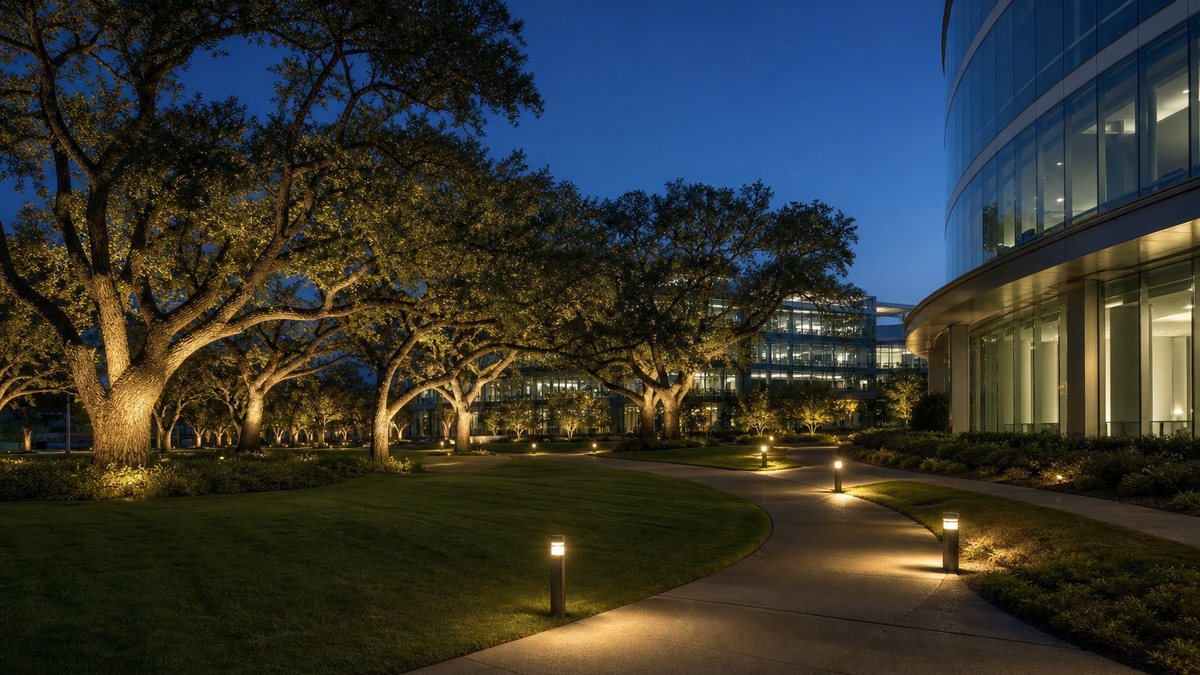
Commercial landscape lighting in Irving turns grounds into part of the property's identity. Las Colinas is known for its canals, lakes, tree-lined boulevards, and landscaped corporate campuses, and after dark those assets either disappear into shadow or become the most memorable part of a visit. Well-designed landscape lighting guides people safely along paths, highlights trees and architecture, brings water features to life, and makes a campus, hotel, or retail center feel welcoming at night.
This guide covers commercial landscape lighting for Irving properties: the main techniques, fixture types, design principles, how to light water features and courtyards, what North Texas conditions demand, how controls save energy, and how to plan a project. It is written for property owners, facility managers, landscape architects, and developers who want grounds that look as good at 9 PM as they do at noon.
Commercial landscape lighting uses low-glare LED fixtures and smart controls to make outdoor spaces safe, attractive, and easy to navigate after dark.
- Pathway lighting: bollards and path lights for safe walkways
- Tree and feature uplighting: depth and drama for trees, sculptures, and walls
- Water feature lighting: fountains, canals, ponds, and reflecting pools
- Courtyards and plazas: layered light for gathering spaces and outdoor dining
- Controls: photocells, astronomical time clocks, dimming, and scenes
- Built for Texas: outdoor-rated, heat-tolerant, sealed, and surge-protected
- Pricing: quoted per property after a site review
Why landscape lighting matters for commercial properties
Landscape lighting does more than decorate. For commercial properties it delivers practical and business value:
- Safety: lit paths, steps, and changes in grade reduce trips and falls.
- Security: well-lit grounds remove hiding places and support camera coverage.
- Wayfinding: light guides visitors from parking to entrances and between buildings.
- Brand and first impressions: lit trees and features signal a premium, well-kept property.
- Longer use of outdoor spaces: courtyards, patios, and plazas stay usable into the evening.
- Tenant and guest experience: employees and guests feel more comfortable arriving and leaving after dark.
In a market like Las Colinas, where Class A office buildings and hotels compete for tenants and guests, the grounds are part of the product.
Core landscape lighting techniques
Uplighting
Fixtures at the base of trees, columns, or walls aim light upward, revealing form and texture. Uplighting mature live oaks and cedar elms is one of the most effective ways to add depth to a campus at night.
Downlighting and moonlighting
Fixtures mounted high in trees or on structures cast soft light downward through branches, creating natural, dappled patterns on lawns and walkways. Moonlighting is subtle and elegant, ideal for courtyards and gathering areas.
Path and area lighting
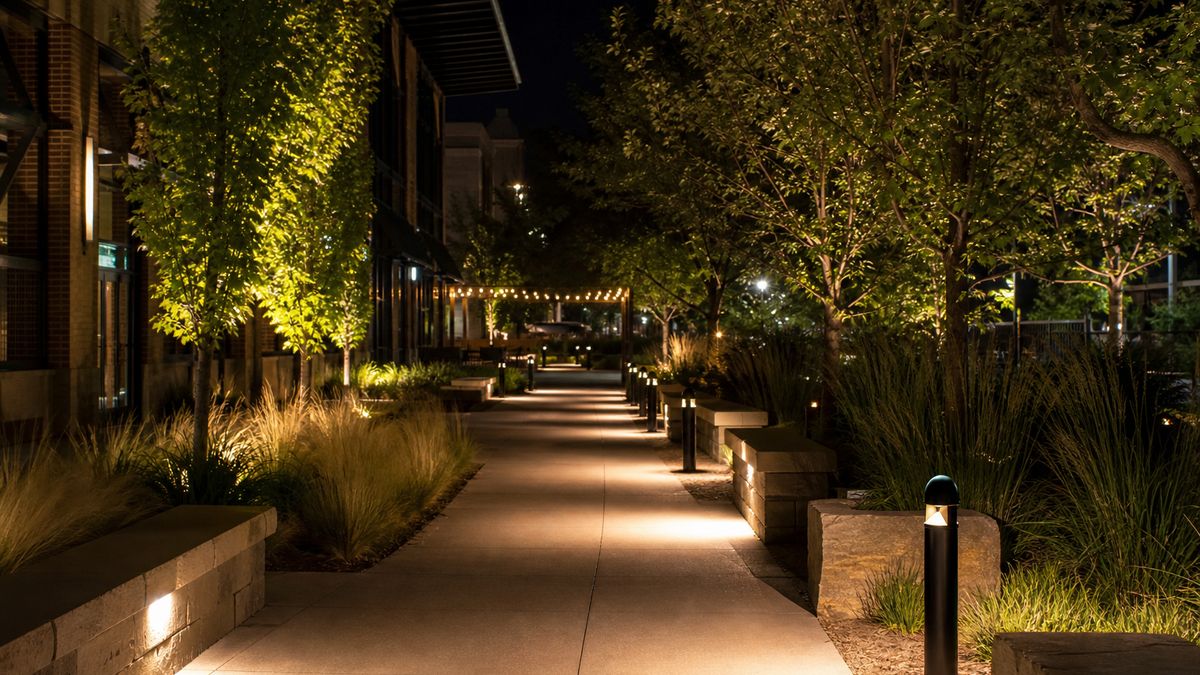
Bollards and path lights provide even, low-glare light along walkways, plazas, and entries, guiding people without blinding them.
Grazing and washing
Light placed close to walls, retaining walls, and stone features brings out texture, while wall washing gives broad, even glow to larger surfaces and signage walls.
Silhouetting and shadowing
Lighting a wall behind a tree or sculpture creates a striking silhouette, while lighting from the front can cast dramatic shadows onto a building face.
Water feature lighting
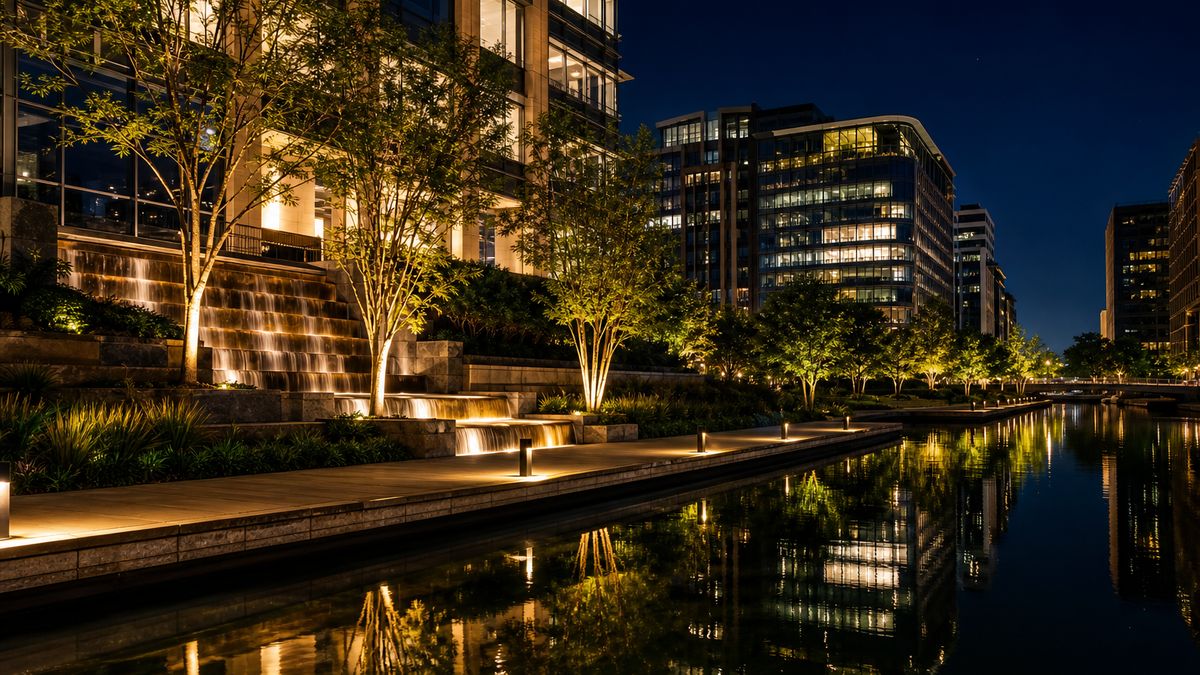
Underwater and edge lighting brings fountains, cascades, canals, and ponds to life, one of the signature looks of Las Colinas.
Fixture types at a glance
| Fixture | Typical use | What to look for |
|---|---|---|
| In-grade uplights | Trees, columns, walls | Drive-over rating where needed, sealed optics, adjustable aiming |
| Spot / accent lights | Trees, sculptures, signs | Interchangeable beam angles, glare shields, locking aim |
| Bollards | Walkways, plazas, entries | Low glare, durable housing, even ground distribution |
| Path lights | Garden paths, beds | Shielded heads, warm color, sturdy stakes or mounts |
| Wall washers / grazers | Walls, signage walls, stone | Outdoor rating, even distribution, discreet profile |
| Downlights / moonlights | Tree canopies, pergolas | Tree-friendly mounts, low glare, weather sealing |
| Underwater fixtures | Fountains, pools, canals | Submersible rating, corrosion resistance, safe low-voltage design |
| Step and wall lights | Stairs, seat walls | Recessed, low glare, impact resistance |
Design principles for great results
- Light the subject, hide the source. Visitors should see glowing trees and paths, not bright fixtures.
- Layer the light. Combine path lighting, uplighting, and accent lighting to create depth instead of flat brightness.
- Use contrast deliberately. Not everything should be lit. Darkness between features makes the lit elements stand out.
- Choose warm color. Around 2700K to 3000K usually looks most natural on foliage and stone.
- Control glare. Shields, louvers, and careful aiming keep light out of eyes and neighboring properties.
- Plan for growth. Trees grow, so choose adjustable fixtures and allow for re-aiming over time.
- Coordinate with other lighting. Landscape, facade, and parking lighting should feel like one design.
Walk the site at night before designing. Features that look important by day are not always the ones that matter after dark, and existing light spill from parking lots or signs changes what needs to be lit.
Lighting for safety without losing atmosphere
Commercial grounds need to be safe first. Walkways, steps, ramps, and entrances need enough light for people to see changes in grade and potential hazards, and parking-to-entrance routes should be continuous without dark gaps. The trick is providing that safety lighting in a way that still feels inviting. Low bollards and step lights put light on the ground where feet go, while uplighting on trees and walls adds ambient brightness that helps people feel secure. Combining the two avoids the harsh, floodlit look of security-only lighting while still keeping the site well lit.
Lighting water features and canals
Water is Las Colinas' calling card, and lighting it well creates unforgettable scenes. Underwater lights below cascades and jets make moving water sparkle; edge lighting along canals and ponds defines shorelines and improves safety; reflections of lit trees and buildings double the effect.
Water feature lighting must be designed for safety and durability: fixtures rated for submersion, corrosion-resistant materials, properly protected low-voltage circuits, and installation that meets electrical code requirements near water. For signature features and pools, our network partners offer 360° laser fiber optic lighting, which keeps electricity away from the water entirely, and premium pool lighting for amenity decks.
Make your grounds shine after dark
Tell us about your property and we will follow up with ideas and a project-specific proposal.
Courtyards, plazas and outdoor dining
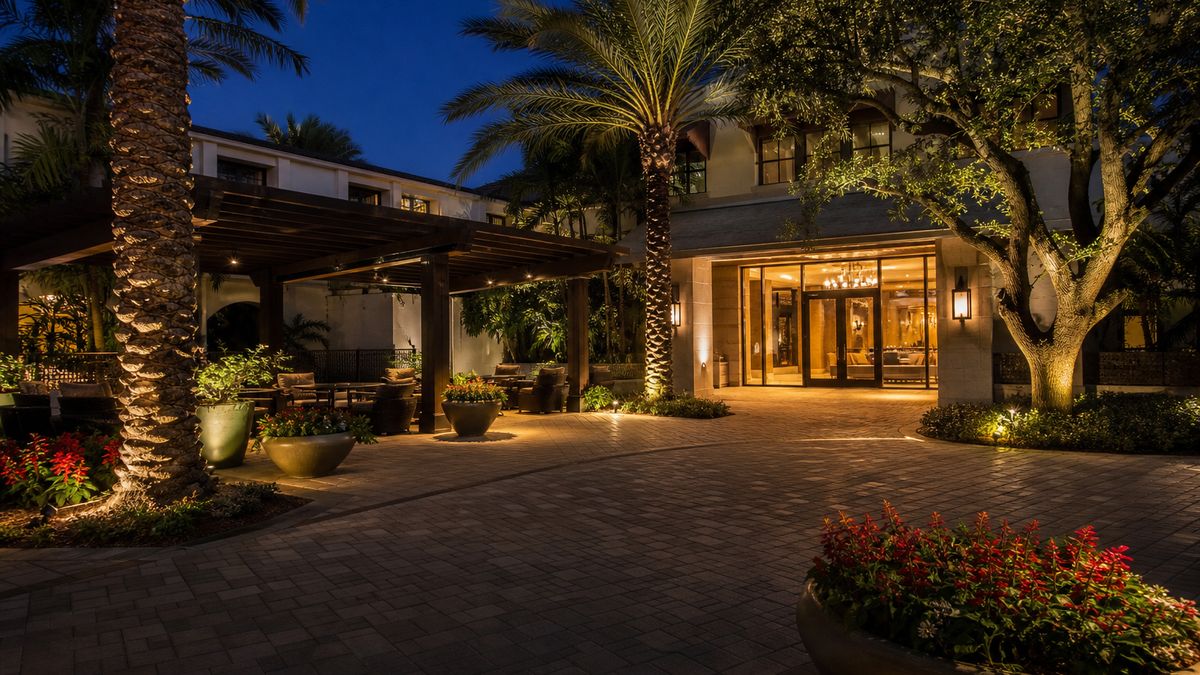
Outdoor gathering spaces have become a major amenity for offices, hotels, and restaurants. Layered lighting makes them usable and inviting after dark: soft downlighting from trees or pergolas, warm accent light on planters and seat walls, low bollards along edges, and decorative fixtures that set the style. Dimmable scenes let a plaza move from bright and active during evening events to calm and relaxed later at night. Around the Toyota Music Factory and the Urban Center, restaurant patios and plazas use this approach to keep guests outside longer.
Built for North Texas conditions
| Condition | What to specify |
|---|---|
| Summer heat | Heat-tolerant drivers and transformers, fixtures with good heat sinking |
| Heavy rain and irrigation | Proper ingress protection, sealed connections, well-drained in-grade fixtures |
| Storms and lightning | Surge protection on circuits and power supplies |
| Clay soils | Stable mounting and drainage for in-grade and stake-mounted fixtures |
| UV exposure | UV-stable finishes, lenses and cable jackets |
| Mowers and foot traffic | Robust housings, recessed or protected placement |
Controls that save energy
Landscape lighting often runs every night, so controls make a real difference:
- Photocells turn lighting on at dusk automatically.
- Astronomical time clocks follow sunset through the seasons and switch off or dim at set times.
- Scheduled dimming reduces light levels late at night while keeping paths safe.
- Scenes for everyday, events, and holidays, including color accents where appropriate.
- Zoning so entrances and paths stay lit while decorative accents turn off overnight.
- Networked control for campuses with many zones, managed alongside building lighting.
For more on control strategies, see our guide to commercial lighting control systems in Irving.
Low-voltage vs line-voltage systems
Commercial landscape lighting uses both approaches. Low-voltage systems, fed by transformers or remote power supplies, are common for path lights, accents, and water features because they are flexible and safer to work with. Line-voltage fixtures suit larger bollards, high-output floodlights, and long runs. Many campuses use both. The right mix depends on distances, fixture types, and how the system will be maintained, and all work should follow applicable electrical code.
Being a good neighbor: dark sky and glare
Good landscape lighting puts light where it is needed and nowhere else. Shielded fixtures, careful aiming, appropriate brightness, and warm color reduce sky glow and light trespass onto neighboring homes. Turning off purely decorative accents late at night saves energy and respects neighbors, while safety lighting on paths and entrances stays on.
Common landscape lighting mistakes
- Runway-style path lights. Evenly spaced lights lining both sides of a path look institutional. Staggered, shielded fixtures feel more natural and still keep paths safe.
- Over-lighting. Too much light flattens a landscape and wastes energy. Subtle contrast is what makes grounds look high-end.
- Visible hot spots. Bare lamps and unshielded fixtures create glare that distracts from the features you are trying to show.
- Cool, harsh color. Cold white light makes foliage look gray and uninviting.
- Ignoring irrigation. Sprinklers aimed at fixtures shorten their life and spot lenses.
- No plan for growth. Fixtures that look perfect on day one can be buried in foliage a year later.
- Mismatched systems. Landscape lights on a different schedule or color from facade and parking lighting look disjointed.
Seasonal and holiday lighting
Many Irving properties dress up their grounds for the holidays and special events. Planning for this in the permanent design saves effort each year: dedicated outdoor-rated power points near key trees and entries, controls that can switch seasonal circuits on a schedule, and color-capable accent fixtures that can shift to holiday or brand colors without extra hardware. Color-changing uplights on signature trees or water features can celebrate events and holidays while staying warm white the rest of the year.
Planning a landscape lighting project
- Night walkthrough. Identify key features, safety needs, dark areas, and existing light spill.
- Concept. Decide what to highlight and the mood for each area.
- Design and layout. Fixture types, locations, beam angles, power, and control zones.
- Mockups. Test key trees and features at night before final placement.
- Proposal. A clear scope and project-specific price.
- Installation. Coordinated with landscapers and irrigation to protect roots, plants, and existing systems.
- Night aiming and programming. Final aiming, scenes, and schedules set after dark.
- Maintenance. Seasonal re-aiming, cleaning, trimming around fixtures, and checks after storms.
Working with landscape architects and developers
On new developments, landscape lighting works best when it is planned alongside planting and hardscape. Early coordination lets conduit, power, and mounting points go in before paving and planting, which avoids costly trenching later. We support landscape architects and developers with fixture recommendations, cut sheets, and coordination with electrical and general contractors, and we can deliver the landscape lighting package as part of a larger site and building lighting scope.
Maintenance and seasonal care
Landscape lighting needs periodic attention to keep looking its best:
- Re-aim fixtures as trees and plants grow
- Trim foliage that blocks fixtures
- Clean lenses of dirt, mulch, and mineral deposits
- Check connections and transformers after storms
- Verify timers and schedules after daylight saving changes
- Replace damaged fixtures from mowers or foot traffic
A maintenance plan keeps the grounds looking consistent all year and catches small issues early.
Landscape lighting for different property types
Corporate campuses
Tree-lined drives, entry plazas, walking paths between buildings, and outdoor seating areas that make campuses feel safe and premium at night.
Hotels and hospitality
Arrival courts, pool decks, courtyards, and gardens that create a welcoming, memorable guest experience.
Retail and mixed-use
Plazas, walkways, and planters that keep shoppers and diners comfortable after dark.
Multifamily communities
Entries, paths, amenity areas, and dog parks that support safety and curb appeal.
Churches and institutions
Grounds, paths, and signature features lit for evening services and events.
Why work with Irving LED Lights
We design, supply, install, program, and service commercial lighting across Irving and Las Colinas, including landscape, facade, parking, and building lighting, so every part of your property works together. Our team brings 15+ years as an authorized architectural lighting dealer and project coordinator, and our licensed installation partner has completed over 200 major sports and commercial projects across the US and Canada. See our guide to commercial outdoor LED lighting in Irving for parking and facade lighting, and our commercial lighting services for everything else we do.
Frequently Asked Questions
What is commercial landscape lighting?
How much does commercial landscape lighting cost in Irving?
What color temperature is best for landscape lighting?
Is LED landscape lighting safe around water features?
How do you control landscape lighting?
Should landscape lighting be low-voltage or line-voltage?
How do you reduce glare from landscape lights?
How often does landscape lighting need maintenance?
What areas do you serve?
Let's light your grounds
Request a consultation and we will follow up to schedule a night walkthrough.
Related
Our DFW lighting network: Dallas commercial LED lighting, Fort Worth LED lighting, Arlington LED lighting, Plano LED lighting, statewide Texas LED lighting, wholesale LED components, fiber optic starlight ceilings, modular building solutions, and Dallas modular structures.