Commercial LED Lighting in Coppell & Valley Ranch, TX: Offices, Warehouses, Retail & Site Lighting
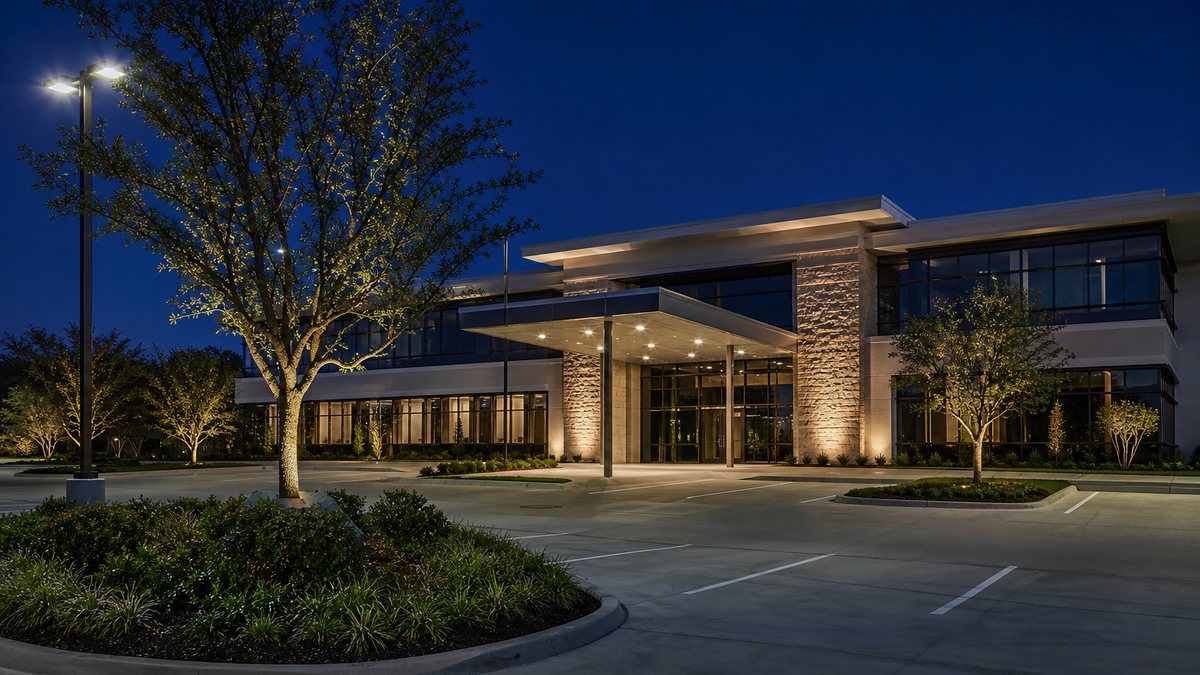
Commercial LED lighting in Coppell and Valley Ranch serves a mix of property types you rarely find side by side: suburban office buildings, flex and light-industrial space, distribution warehouses on the north side of DFW Airport, neighborhood retail centers, medical offices, schools, churches, and mixed-use districts. Each one has different lighting needs, but the goals are the same everywhere: spaces that are comfortable to work in, sites that feel safe after dark, lower energy and maintenance effort, and lighting that meets code the first time it is inspected.
This guide is written for property owners, facility managers, business owners, and developers in Coppell, Valley Ranch, and the surrounding north Irving and DFW Airport area. It explains what to light and how, the fixture and control choices that make sense for each building type, how local conditions and codes shape a project, and how to plan an upgrade or new installation from first walkthrough to final aiming. Irving LED Lights is based in the same corridor, so Coppell and Valley Ranch are core parts of our service area, not an afterthought.
Commercial LED lighting for Coppell and Valley Ranch properties combines efficient interior fixtures, low-glare exterior and site lighting, and code-compliant controls, designed around how each building is actually used.
- Offices and medical: low-glare troffers and linear fixtures, daylight and occupancy controls
- Warehouses and flex space: LED high bays with aisle optics, sensors, and dock lighting
- Retail and mixed-use: storefront, canopy, signage, and pedestrian lighting
- Site lighting: parking, wall packs, entries, and landscape with shielded optics
- Controls: sensors, dimming, schedules, and networked systems for energy code compliance
- Local service: based in the Irving and DFW Airport corridor, minutes from Coppell and Valley Ranch
- Pricing: quoted per project after a site review
Why Coppell and Valley Ranch need a local approach
Coppell and Valley Ranch sit next to each other on the north side of DFW Airport, with Valley Ranch forming the northern part of Irving and Coppell directly beyond it. Together they cover a wide range of commercial property in a compact area. Along the Freeport Parkway, Belt Line Road, and the highway corridors near the airport you find warehouses, distribution centers, flex buildings, and office parks. Closer to the neighborhoods you find retail centers, restaurants, medical and professional offices, schools, places of worship, and community buildings. Old Town Coppell and the canal-lined areas of Valley Ranch add walkable, mixed-use settings where pedestrian lighting and atmosphere matter as much as foot-candles.
That mix means there is no single "Coppell lighting package." A distribution building needs bright, uniform light at height and safe dock and truck-court lighting. A dental office needs comfortable, low-glare light and accurate color. A retail strip needs storefronts that stand out from the road and parking that feels safe at closing time. A church needs flexible lighting that works for services, events, and quiet weekday use. The right approach starts with how each building is used and who uses it, then chooses fixtures and controls to fit.
Being local also matters for practical reasons. Night walkthroughs, mockups, aiming sessions, and follow-up service are easier when the team is close by, and familiarity with the area's property types, utility service territory, and permitting expectations helps projects move smoothly.
Property types we light in Coppell and Valley Ranch
| Property type | Main lighting priorities | Typical solutions |
|---|---|---|
| Suburban offices and office parks | Visual comfort, screen-friendly light, energy code controls | Low-glare troffers, linear pendants, daylight and occupancy sensors, tunable white where useful |
| Warehouses and distribution | Uniform light at height, safety, lower maintenance | LED high bays with aisle optics, high-bay sensors, dock and truck-court lighting |
| Flex and light industrial | Mixed office and work areas under one roof | Separate zones and controls for office front and warehouse back |
| Retail centers and restaurants | Visibility from the road, safe parking, inviting storefronts | Canopy lights, storefront accents, pole and wall lighting, signage lighting |
| Medical and dental offices | Comfort, accurate color, clean appearance | High color-rendering fixtures, task lighting, dimming in patient areas |
| Churches and community buildings | Flexible scenes for services and events | Dimmable house lighting, accent and stage lighting, exterior and parking lighting |
| Schools and training facilities | Glare control, durability, controls | Classroom-friendly fixtures, gym high bays, site and walkway lighting |
| Mixed-use and walkable districts | Pedestrian comfort, atmosphere, safety | Decorative poles, bollards, festoon and accent lighting, landscape lighting |
Office and professional buildings: comfort first
Many Coppell and Valley Ranch office buildings were built with fluorescent troffers that are now past their best. Upgrading to LED is the obvious first step, but the bigger improvements come from how the light is delivered and controlled.
Low-glare fixtures for screen work
People spend most of the day looking at monitors. Fixtures with good optics, diffuse lenses, and low surface brightness reduce glare and reflections on screens. Indirect or direct-indirect pendants in open offices light the ceiling as well as the work surface, which makes rooms feel brighter and more open at the same light level.
Color quality and color temperature
Neutral white around 3500K to 4000K is common for offices, with warmer tones in lobbies, break rooms, and amenity spaces. High color rendering makes skin tones, materials, and finishes look natural, which matters in client-facing spaces and medical offices.
Controls that match how the space is used
Occupancy sensors in private offices, conference rooms, and restrooms, daylight dimming near windows, and scheduled shutoff after hours are standard energy code expectations for most new work and major renovations. Done well, they are invisible to occupants: lights are on when people are there and dim or off when they are not. For a deeper look at code requirements, see our guide to lighting controls and energy code compliance in Irving, and for larger multi-tenant buildings, our guide to Class A office lighting upgrades.
Lobbies and first impressions
A lobby is where tenants and visitors form their first opinion of a building. Layered lighting, with wall washing, accent light on artwork or feature walls, and decorative fixtures over reception, makes a modest lobby feel considered and premium. Some properties also add a lobby LED video wall for branding, wayfinding, or tenant communication.
Warehouses, distribution and flex buildings
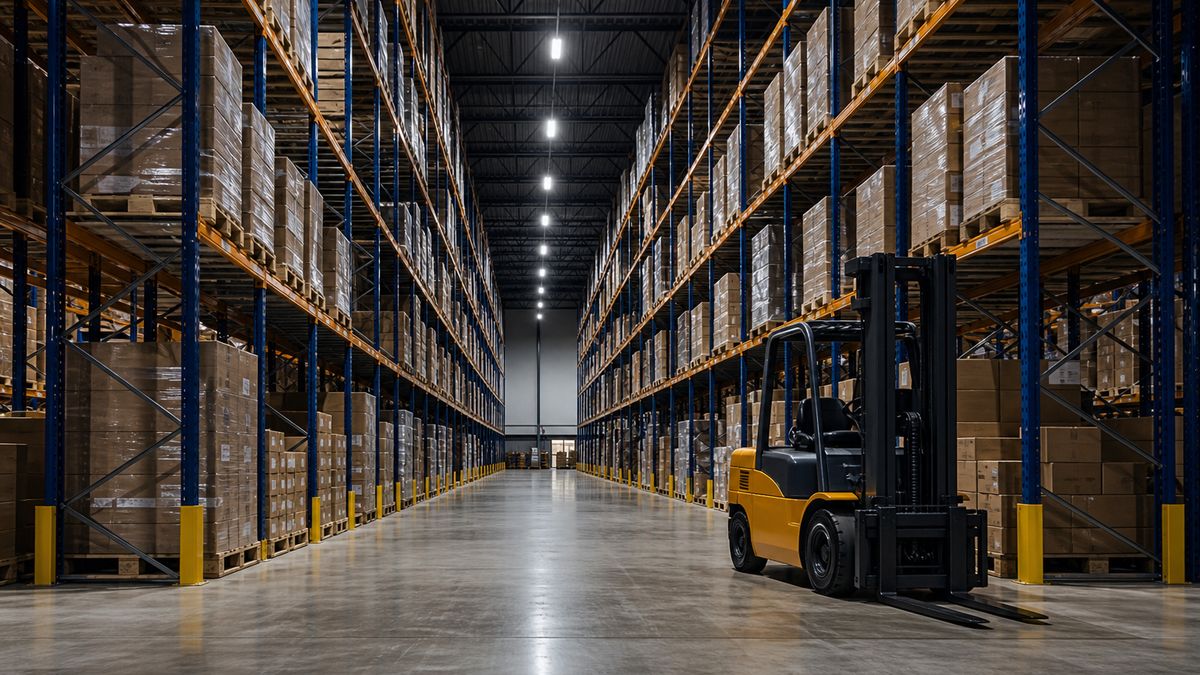
The industrial and logistics properties north of DFW Airport are some of the best candidates for LED upgrades, because the lights run long hours, the fixtures are hard to reach, and old metal halide or fluorescent high bays degrade quickly.
- High bays matched to mounting height: fixture output and optics are chosen for the clear height and rack layout, not just swapped one-for-one.
- Aisle optics: narrow distributions put light down racked aisles and onto vertical rack faces where pickers need to read labels.
- Fixture-integrated sensors: aisles and zones dim or switch off when empty and return to full light instantly when a forklift or person enters.
- Dock and trailer lighting: bright, glare-controlled light at dock doors and inside trailers improves loading safety.
- Truck courts and yards: pole and wall lighting with good uniformity and shielding for night operations.
- Flex offices: the office front of a flex building gets office-style lighting and controls, separate from the warehouse zone.
Instant-on LED also removes the long warm-up times of metal halide, so sensors can turn lights off without delaying work. Our full guide to warehouse and logistics lighting near DFW Airport covers high bay selection, controls, and loading docks in more detail, and our guide to data center lighting covers mission-critical facilities in the same corridor.
Retail centers, restaurants and storefronts
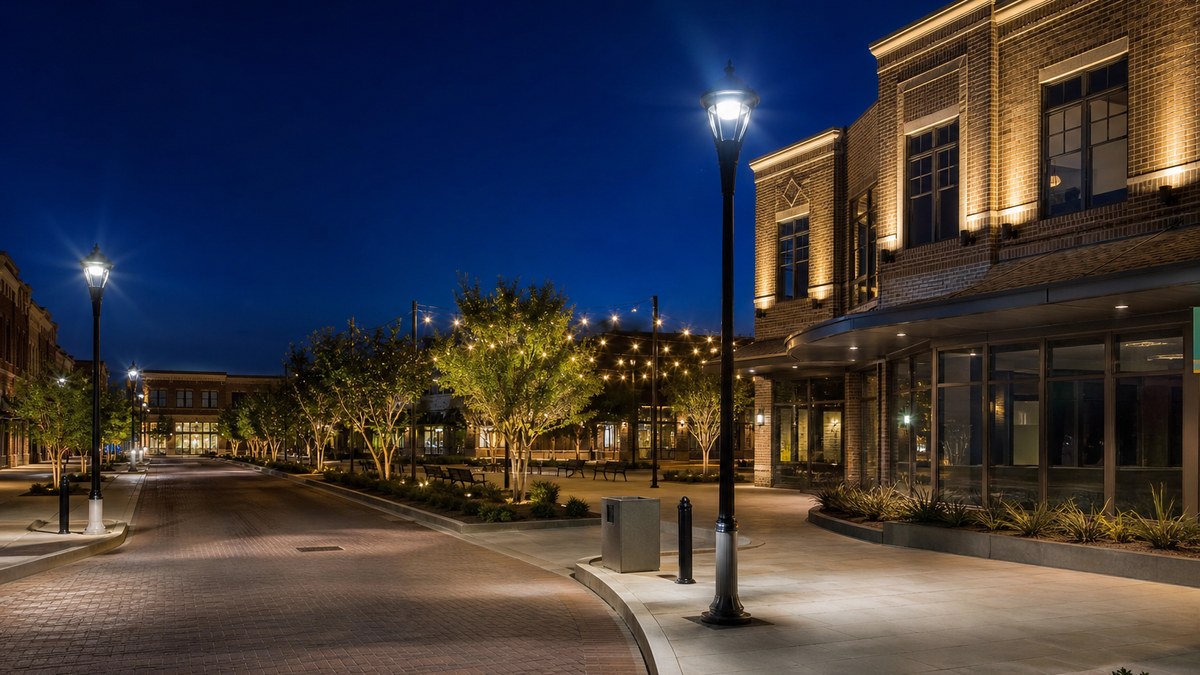
Neighborhood retail in Coppell and Valley Ranch competes for attention from busy roads and for comfort after dark. Lighting does a lot of that work:
- Storefront and facade lighting makes tenants visible from the parking lot and the road, and makes the center look cared for.
- Canopy and walkway lighting keeps covered walks bright and even, without dark spots between tenants.
- Parking lot lighting with good uniformity and shielded optics helps customers and staff feel safe walking to their cars.
- Sign lighting keeps monument and tenant signs readable without glare.
- Interior retail lighting with high color rendering and accent lighting helps merchandise look its best.
Restaurants and patios benefit from warmer, dimmable lighting and outdoor accents that keep guests comfortable into the evening. Our restaurant and entertainment lighting guide covers dining rooms, bars, and patios, and our commercial outdoor LED lighting guide goes deeper on facades and parking lots.
If tenants are on different lighting schedules, zone the exterior so shared areas like parking and walkways follow a center-wide schedule, while storefront and sign lighting can follow each tenant's hours. It avoids a center that looks closed while some businesses are still open.
Medical, dental and professional offices
Medical and dental practices have particular lighting needs. Exam and treatment areas need bright, high color-rendering light so clinicians can see accurately. Waiting rooms and consultation rooms benefit from softer, warmer, dimmable light that helps patients feel at ease. Corridors and storage areas suit occupancy sensors. Fixtures should be easy to clean, and lenses should hide the LED sources to avoid glare for patients lying back in a chair. Specialized task lighting for procedures is usually specified alongside the general lighting, so coordination between the lighting design and the equipment plan matters.
Churches, schools and community buildings
Places of worship and community buildings are used in very different ways across the week. A sanctuary may need bright, even light for a weekday event, a softer scene for a service, and focused light on a stage or platform. Dimmable LED house lighting, scene control, and dedicated stage or accent lighting make that flexibility simple, often with a small wall station or tablet interface volunteers can use confidently. Gyms and multipurpose rooms suit LED high bays with impact-resistant guards, and parking lots and walkways need dependable lighting for evening events. Schools and training spaces benefit from low-glare classroom fixtures, durable housings, and controls that shut lights off when rooms are empty.
Site, parking and exterior lighting
Exterior lighting is where a property makes its after-dark impression, and where a lot of older fixtures still run on metal halide or high-pressure sodium lamps. Upgrading site lighting to LED improves color, uniformity, and control, and reduces how often lifts are needed for lamp changes.
| Area | What good lighting looks like | Key specifications |
|---|---|---|
| Parking lots | Even light without dark gaps, minimal glare | Full-cutoff area lights, appropriate pole spacing and optics, house-side shields near property lines |
| Building perimeter | Lit doors and walls, no hiding spots | Shielded wall packs, door lights, controls with motion response where allowed |
| Entries and drop-offs | Welcoming, clearly lit arrival | Canopy downlights, accent lighting, warmer color |
| Truck courts and yards | Bright, uniform light for night operations | High-output pole and wall lighting with good uniformity |
| Walkways and plazas | Comfortable pedestrian lighting | Bollards, pedestrian poles, step lights, low glare |
| Signage and monuments | Readable without hot spots | Ground-mounted or integrated sign lighting, aimed and shielded |
Good exterior lighting is also good neighbor lighting. Many Coppell and Valley Ranch commercial properties back onto homes, so shielded optics, careful aiming, and late-night dimming help keep light on the site and out of bedroom windows. Structured parking has its own requirements; see our guide to parking garage LED lighting.
Plan your lighting upgrade
Tell us about your building and we will follow up to schedule a walkthrough and prepare a project-specific proposal.
Landscape, canals and mixed-use districts
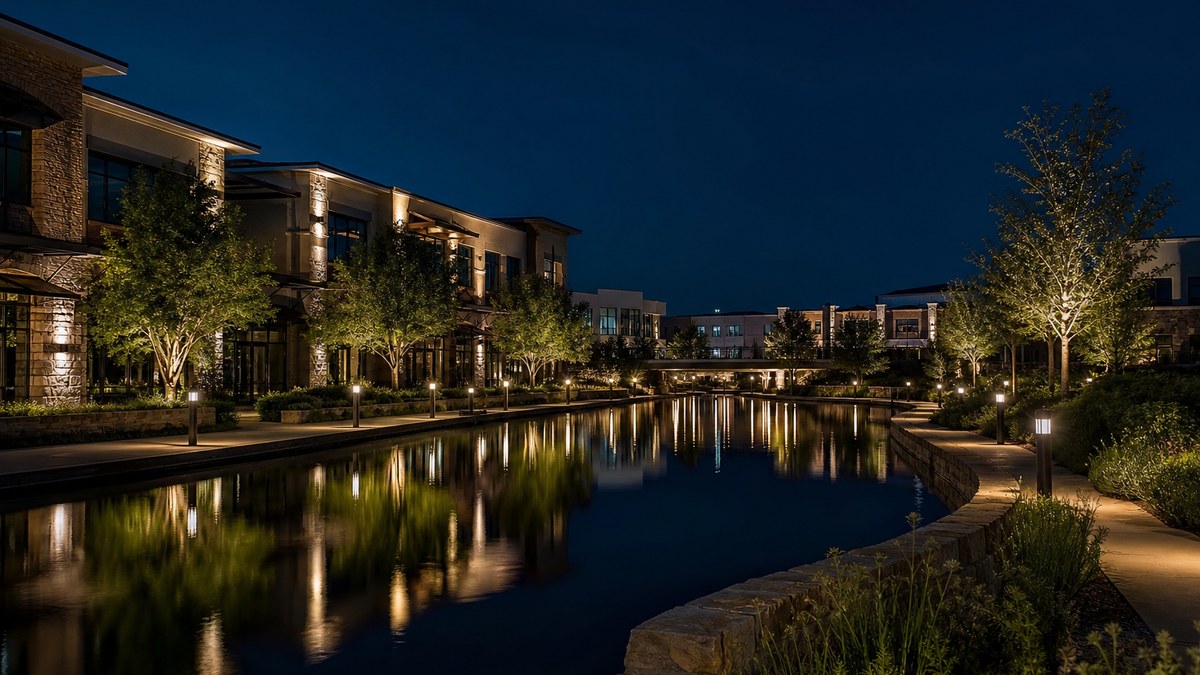
Valley Ranch is known for its canals and landscaped streets, and Old Town Coppell is built around a walkable, small-town style district. Properties in settings like these benefit from lighting that adds atmosphere as well as safety: uplit trees, softly lit paths, lit water edges, decorative pedestrian poles, and warm accent lighting on building facades and gathering spaces. The key is restraint. Warm color, shielded fixtures, and contrast between lit and unlit areas look more refined than flooding everything with light.
Our guide to commercial landscape lighting in Irving covers techniques for trees, paths, water features, and courtyards that apply directly to Valley Ranch and Coppell properties. For signature water features, network partner 360° fiber optic lighting keeps electricity away from the water entirely.
Lighting controls and energy codes
Controls are where much of the long-term energy value of an LED project comes from, and they are also where many projects run into trouble at inspection. For new construction, additions, and significant lighting alterations, the applicable energy code typically calls for automatic shutoff, occupancy sensing in certain spaces, daylight-responsive controls near windows and skylights, and exterior controls that switch or reduce lighting overnight. The exact requirements depend on the code edition the jurisdiction enforces and the scope of work, so the first step is confirming with the City of Coppell or the City of Irving which edition applies to your permit.
Common control strategies for Coppell and Valley Ranch buildings include:
- Occupancy and vacancy sensors in offices, conference rooms, restrooms, storage, and warehouse aisles.
- Daylight dimming in perimeter offices, lobbies, and spaces with skylights.
- Time schedules that shut off or reduce lighting after hours, with local override.
- Exterior controls with photocells, astronomical clocks, and overnight dimming.
- High-end trim to set maximum light levels so spaces are not over-lit.
- Networked lighting controls for larger buildings and campuses, with central scheduling and reporting.
Systems range from simple standalone sensors to DALI, 0-10V, and wireless networked platforms. Our guide to commercial lighting control systems explains the options, and our emergency and egress lighting guide covers the life-safety lighting that must keep working when the power does not.
Energy savings and utility incentives
Replacing fluorescent, metal halide, and high-pressure sodium lighting with LED, and adding controls, generally reduces lighting energy use and maintenance effort significantly. LED fixtures last much longer than the lamps they replace, which means fewer lift rentals and service calls, especially for high bays, parking lot poles, and tall lobby ceilings. The actual savings depend on the existing system, operating hours, the new design, and how the controls are set up, so we evaluate each building individually rather than quoting generic figures.
Commercial customers in the area may qualify for energy efficiency incentives through Oncor, depending on program availability, eligibility rules, and timing at the time of the project. Programs typically require pre-approval before work begins, so incentive paperwork should be part of the plan from the start. We can help identify whether a project may qualify.
Retrofit, relamp or full replacement?
Not every building needs brand-new fixtures. Choosing the right path depends on the condition of existing fixtures, ceiling type, how much the layout needs to change, and what the owner wants from the upgrade.
| Approach | When it fits | Considerations |
|---|---|---|
| LED lamps (relamp) | Fixtures in good condition, short-term or simple needs | Least disruption; limited control and optical improvement |
| Retrofit kits | Sound housings, ceiling stays in place | New optics and drivers in existing housings; good balance of improvement and disruption |
| New fixtures | Old or damaged fixtures, layout or ceiling changes, renovations | Best optical performance and control integration; more installation work |
| Redesign with controls | Tenant improvements, major renovations, poor existing layout | Best long-term result; typically triggers energy code control requirements |
Our guide to affordable commercial LED lighting upgrades explains how to get the most light and value from a budget, including when retrofit kits make more sense than new fixtures.
Planning a commercial lighting project
- Walkthrough and audit. We review existing fixtures, light levels, controls, ceiling conditions, problem areas, and how the building is used, including a night visit for exterior work.
- Goals and priorities. Energy, comfort, appearance, safety, maintenance, tenant needs, and timing.
- Design. Fixture selection, layout, light levels, color temperature, and control zones, with photometric calculations where needed.
- Code and incentive review. Confirm energy code and permit requirements and identify possible utility incentives.
- Proposal. A clear scope and project-specific price.
- Scheduling. Phased or after-hours work to keep tenants, customers, and operations running.
- Installation. Coordinated with building management, electrical contractors, and other trades.
- Commissioning. Sensors calibrated, schedules programmed, exterior lights aimed, and controls tested.
- Handover and support. Documentation, training for facility staff, and ongoing service.
Working around tenants and operations
Most commercial lighting upgrades in Coppell and Valley Ranch happen in occupied buildings. Offices stay open, warehouses keep shipping, and retail tenants keep trading. Good planning keeps disruption low: phasing work floor by floor or zone by zone, working nights or weekends where needed, protecting finishes and inventory, keeping egress paths lit throughout, and communicating clearly with tenants about schedules. For warehouses, work is planned around shifts and dock activity, and lifts are scheduled so they do not block traffic. For retail, exterior and canopy work is often done outside trading hours.
North Texas conditions to design for
Exterior lighting in Coppell and Valley Ranch has to handle long, hot summers, intense sun, heavy storms, hail, and lightning. Specifying for these conditions avoids early failures:
- Heat-rated drivers and good thermal design so fixtures run cool and last.
- Surge protection on exterior fixtures and circuits to guard against storm-related damage.
- Sealed, outdoor-rated housings with appropriate ingress protection for rain and irrigation.
- UV-stable lenses and finishes that do not yellow or chalk in the sun.
- Solid pole and mounting design suited to local wind conditions.
- Impact-resistant fixtures where vandalism or equipment contact is a risk.
Common mistakes to avoid
- One-for-one swaps without a design check. Replacing every old fixture with the same number of LEDs can leave spaces over-lit or poorly distributed.
- Ignoring glare. Bright, exposed LEDs in offices and parking lots cause discomfort and complaints.
- Skipping controls. Lights left on in empty spaces waste much of the benefit of LED, and missing controls can fail inspection.
- Mixed color temperatures. Patchwork upgrades with different whites make buildings look unfinished.
- Forgetting emergency lighting. Egress lighting and exit signs must be included in the plan and tested.
- No commissioning. Sensors and schedules left at factory settings rarely match how a building is used.
- Light trespass. Unshielded site lighting next to homes creates neighbor complaints.
Beyond general lighting: video walls, signage and architectural lighting
Many Coppell and Valley Ranch businesses want more than efficient general lighting. We also provide LED video walls for lobbies, conference rooms, training spaces, and churches; LED signage for retail and office properties; and architectural and facade lighting that gives buildings a distinctive night presence. For hospitality properties, see our guide to hotel lighting in Irving and Las Colinas. For complete design-build lighting transformations, our Luminance program brings design, fixtures, installation, and controls together under one plan.
Why work with Irving LED Lights
Irving LED Lights designs, supplies, installs, programs, and services commercial lighting across Irving, Las Colinas, Valley Ranch, Coppell, and the DFW Airport corridor. Because we are local, we can walk your site at night, attend mockups, and come back for aiming and service without long lead times. Our team brings 15+ years as an authorized architectural lighting dealer and project coordinator. Our licensed installation partner has completed over 200 major sports and commercial projects across the US and Canada — NFL, NBA, NHL, MLS, NCAA and NASCAR. Learn more about our team, browse our commercial lighting services, or see the areas we serve. For a broader overview of the market we work in, read what Las Colinas businesses need to know about commercial LED lighting.
Frequently Asked Questions
Do you provide commercial LED lighting in Coppell and Valley Ranch?
How much does a commercial LED lighting upgrade cost in Coppell?
Should I retrofit my existing fixtures or replace them?
Do lighting upgrades in Coppell need to meet the energy code?
Can LED upgrades qualify for utility incentives?
What lighting works best for warehouses near DFW Airport?
What color temperature should an office use?
How do you keep parking lot lighting from bothering nearby homes?
Can work be done without disrupting tenants or operations?
How do I get started?
Better light for Coppell & Valley Ranch
Request a consultation and we will follow up to schedule a walkthrough of your property.
Related
Our DFW lighting network: Dallas commercial LED lighting, Fort Worth LED lighting, Arlington LED lighting, Plano LED lighting, statewide Texas LED lighting, wholesale LED components, fiber optic starlight ceilings, American LED signage, modular building solutions, and Dallas modular structures.