Retail & Shopping Center LED Lighting in Irving, TX: Storefronts, Parking Lots, Signage & Holiday Lighting
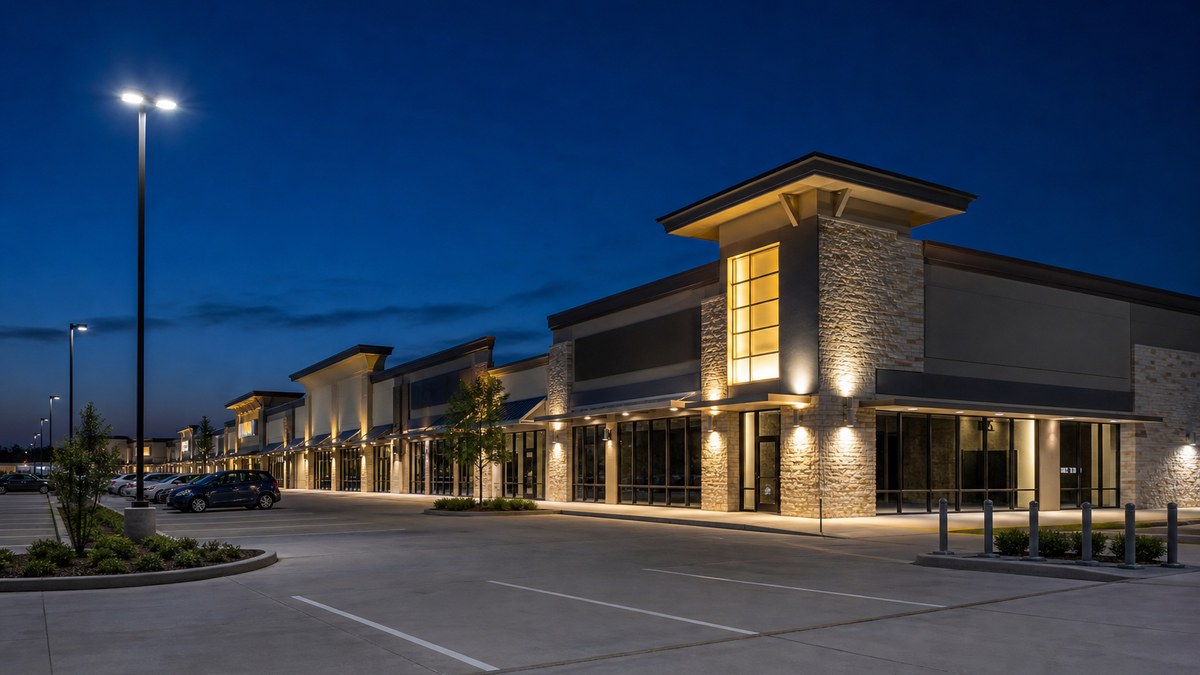
Retail and shopping center LED lighting in Irving decides whether a center feels open, safe and worth visiting after dark, or tired and easy to drive past. From neighborhood strip centers along Irving's busy arterials to mixed-use plazas in Las Colinas and Valley Ranch, the lighting on the storefronts, canopies, signs and parking field is often the first thing a shopper notices, and the last impression they leave with. Modern LED lighting and controls make it possible to improve all of that while lowering energy use and maintenance across the property.
This guide is written for shopping center owners, property managers, retail tenants and developers in Irving, Las Colinas, Valley Ranch and the DFW Airport corridor. It covers every layer of retail lighting: the parking lot, building facade and canopy, storefronts and tenant signage, store interiors, common areas, controls, holiday and seasonal lighting, and how to plan an upgrade without disrupting business.
Retail and shopping center LED lighting combines exterior site lighting, facade and canopy lighting, storefront and sign lighting, and interior merchandise lighting into one coordinated system that attracts shoppers, improves safety and reduces operating costs.
- Parking lot: uniform, low-glare LED area lights with good vertical light for cameras and faces
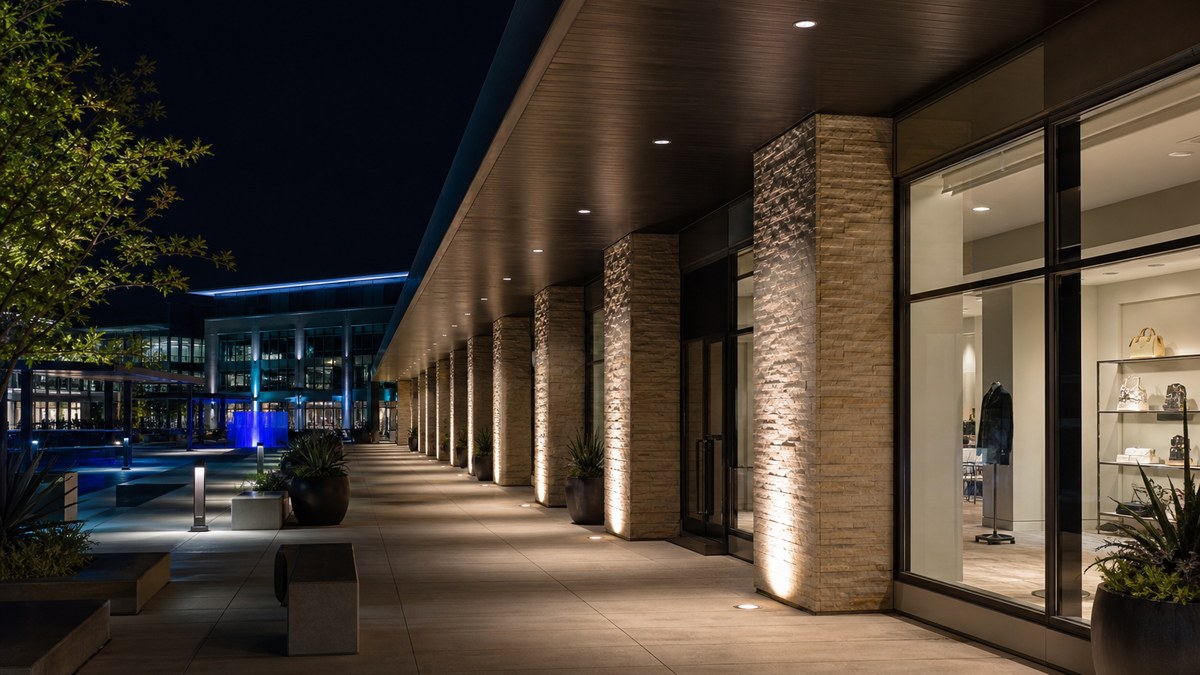
- Facade and canopies: washed walls, lit columns and soffit downlights that make the center visible from the road
- Storefronts and signage: consistent color and brightness so every tenant looks open and well kept
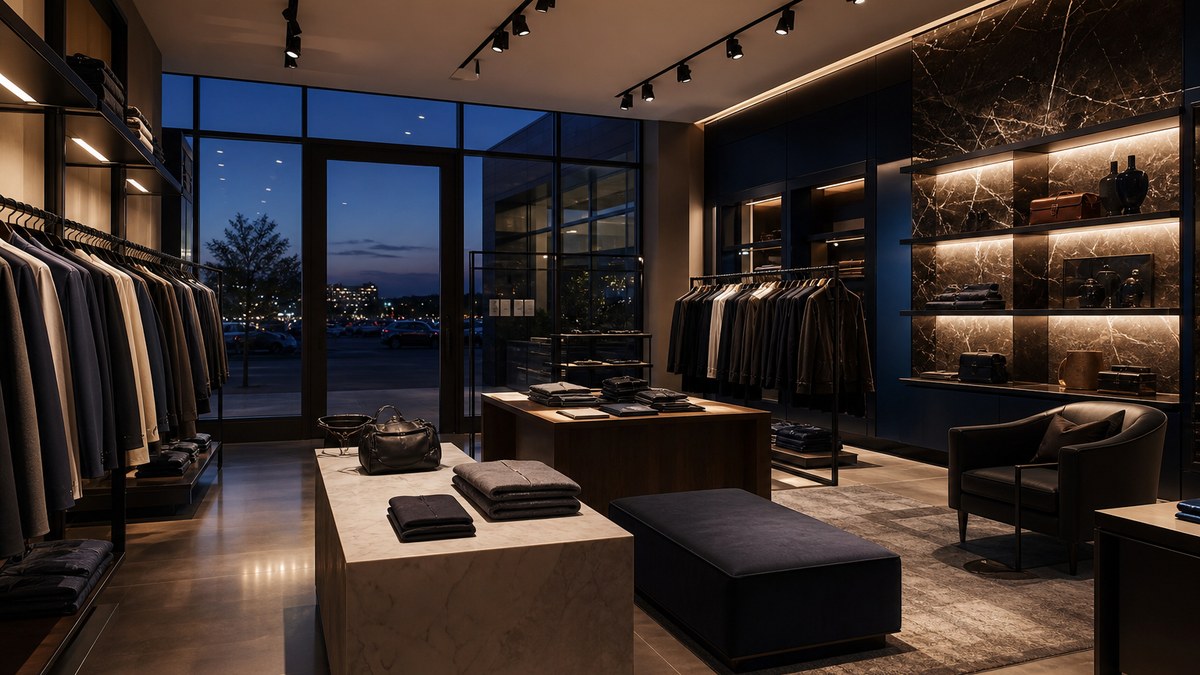
- Interiors: high color rendering (CRI 90+) and layered accent light that sells merchandise
- Controls: dusk-to-dawn scheduling, after-hours dimming and motion response
- Holiday lighting: permanent color-capable fixtures and seasonal power planned into the design
- Pricing: quoted per property after a site review and night walkthrough
Why lighting matters for retail properties
Retail is one of the few property types where lighting directly affects revenue. A shopper deciding where to stop on the way home makes that choice in seconds, and the visual signal of a bright, clean, well-lit center is a powerful one. Lighting supports a shopping center in several ways:
- Visibility from the road: lit facades, pylons and canopies tell drivers the center is open and active.
- Perceived safety: uniform parking lot lighting without dark pockets helps shoppers feel comfortable walking to their cars.
- Security: good vertical illumination supports camera coverage and reduces hiding places behind buildings and in service areas.
- Tenant success: storefronts that look open and inviting help every tenant, which supports occupancy and lease renewals.
- Merchandise presentation: high-quality interior light shows true color and texture, which matters for apparel, food, beauty and home goods.
- Operating costs: LED fixtures and controls typically use far less energy than older metal halide, high-pressure sodium and fluorescent systems, and they need much less frequent relamping.
For centers competing with newer mixed-use developments around Las Colinas and the DFW Airport corridor, a lighting upgrade is one of the most visible improvements an owner can make for the investment involved.
The layers of shopping center lighting
The best retail properties treat lighting as one connected design rather than a collection of separate fixtures installed over decades. Here is how the layers fit together.
| Layer | Typical fixtures | Main goal |
|---|---|---|
| Parking field | Pole-mounted LED area lights, shielded optics | Uniform, safe, camera-friendly light from car to door |
| Building facade | Wall washers, grazers, linear LED, wall packs | Visibility from the road and a cohesive identity |
| Canopies and walkways | Soffit downlights, column uplights, linear coves | Comfortable, bright pedestrian zone along storefronts |
| Storefronts | Display window lights, entry downlights | Make every tenant look open and inviting |
| Signage | LED channel letters, cabinet retrofits, pylon signs, digital displays | Brand recognition and wayfinding |
| Store interiors | Troffers, track, accent, linear and case lighting | Merchandise presentation and comfortable shopping |
| Service areas | Wall packs, area lights at docks and dumpsters | Security and safe deliveries |
| Landscape and plazas | Uplights, bollards, string and decorative lights | Atmosphere and longer evening visits |
Parking lot lighting: the first impression
The parking field is where most shoppers first experience a center at night, and it is also where many older Irving centers show their age. Common problems include orange-tinted sodium light, dim poles with failed lamps, bright hot spots directly under poles with dark gaps between them, and glare that spills onto neighboring streets and homes.
An LED parking lot upgrade addresses these issues with:
- Better uniformity: modern optics spread light evenly across the lot so there are fewer dark pockets between poles.
- Improved color: neutral white light helps shoppers recognize their cars, read signs and see faces, and gives cameras cleaner images.
- Glare and spill control: fully shielded fixtures and the right distribution keep light on the property rather than in drivers' eyes or neighbors' windows.
- Controls: photocells and schedules turn lights on at dusk, and dimming or motion response can reduce output after stores close while keeping the site secure.
- Reduced maintenance: long-life LED fixtures mean far fewer lift-truck visits to replace lamps on tall poles.
Before changing fixtures, a photometric layout should confirm pole spacing, mounting heights and optics, because a one-for-one swap does not always fix the uniformity problems of the original design. Our guide to commercial outdoor LED lighting in Irving goes deeper into parking and site lighting, and centers with structured parking can review our parking garage LED lighting guide.
Do a night walk of the lot from the far parking rows to the storefronts. The route shoppers actually take after dark, including crosswalks, cart corrals and the path around the end-cap, is where dark spots and glare matter most.
Facades, canopies and walkways
The building itself should read clearly from the road. In a typical Irving strip or neighborhood center, that means lighting the parapet and facade so the center has a recognizable shape at night, lighting columns and tower elements as visual anchors, and putting comfortable, even downlight under canopies where shoppers walk.
Facade washing and accent lighting
Linear LED wall washers and grazers bring out texture on stone, stucco and brick and make the architecture visible from a distance. Tower elements and entry features can be accented to draw the eye, and color-capable fixtures let the center change looks for holidays or events while staying warm white the rest of the year.
Canopy and soffit lighting
Old canopy fixtures are often a mix of different lamps and colors installed by different tenants over time. Replacing them with matching LED downlights or linear fixtures gives the whole walkway a consistent color and brightness, which instantly makes a center look better maintained.
Walkway safety
Walkways, curb ramps, steps and crosswalks need enough light to see changes in grade. Consistent canopy lighting combined with well-placed parking lot fixtures keeps the route from car to door continuous without dark gaps.
Storefronts and tenant signage
Signs are the center's voice at night. LED signage uses less energy than older neon and fluorescent cabinet signs, offers more even illumination, and requires less maintenance. Common upgrades include:
- Channel letter retrofits: replacing old neon or fluorescent tubes with LED modules for even, bright letters.
- Cabinet sign retrofits: LED retrofit kits that eliminate dark bands and dead tubes in box signs.
- Pylon and monument signs: LED lighting for multi-tenant pylons so every panel reads clearly from the road.
- Digital displays: LED message centers and displays for centers that want to promote events, tenants and seasonal offers, subject to local sign regulations.
Landlords can also help tenants by setting simple lighting standards for storefronts, such as color temperature, sign hours and display window lighting, so the whole center reads as one coherent destination. Sign permits and rules are set locally, so confirm requirements with the City of Irving before changing sign size, brightness or type. See our LED signage services and our guide to LED video walls in Irving for digital display options.
Store interiors: lighting that sells
Inside the store, lighting is part of merchandising. A good retail lighting plan uses layers:
- Ambient light from troffers, linear fixtures or high bays that makes the space feel open and easy to navigate.
- Accent light from track heads and adjustable downlights that highlights displays, mannequins, endcaps and feature walls.
- Task and case lighting for checkout counters, fitting rooms, shelving and refrigerated or display cases.
- Decorative light such as pendants and coves that reinforce the brand's style.
Color quality for merchandise
Color rendering is critical in retail. Fixtures with a CRI of 90 or higher show fabrics, cosmetics, produce and finishes closer to how they look in daylight, which reduces surprises and returns. Many retailers also look at R9 (saturated red) performance for food, apparel and skin tones.
Choosing color temperature
| Retail type | Typical color temperature | Why |
|---|---|---|
| Boutiques, apparel, home decor | Around 3000K | Warm, inviting, flattering on fabrics and skin |
| Grocery and convenience | 3500K to 4000K, with tuned case lighting | Clean and bright, with special care for produce, meat and bakery |
| Electronics, pharmacy, service | 3500K to 4000K | Crisp and clear for reading labels and packaging |
| Restaurants and cafes | 2700K to 3000K, dimmable | Comfortable ambiance that changes through the day |
| Fitness, salons, medical retail | 3500K to 4000K, high CRI | Accurate color and energetic, clean feel |
Tunable-white fixtures allow color temperature to shift by season, time of day or display, which suits flagship stores and showrooms. For restaurant tenants, our guide to restaurant and entertainment lighting in Irving covers dining rooms, bars and patios in detail.
Glare and comfort
Shoppers should notice products, not light sources. Low-glare optics, well-aimed accent lights and shielded fixtures reduce eye strain and make aisles more comfortable to browse, especially in stores with long operating hours.
Make your center stand out after dark
Tell us about your shopping center or store and we will follow up with ideas and a project-specific proposal.
Controls that cut costs without dark storefronts
Retail properties have predictable schedules, which makes them ideal for lighting controls. Practical strategies include:
- Astronomical time clocks and photocells that track sunset through the seasons, so exterior lights come on when needed rather than on a fixed timer.
- After-hours dimming of parking and facade lighting once stores close, while keeping safety and security levels.
- Motion response in parking areas, service drives and back-of-house corridors so light rises when someone is present.
- Zoning by tenant and area so a late-night restaurant can stay brightly lit while the rest of the center steps down.
- Daylight response near storefront glass and skylights inside stores.
- Networked control that lets property managers adjust schedules and see fixture status from one dashboard.
Controls also help with energy code compliance on renovations and new construction. For details, see our guides to commercial lighting control systems and lighting controls and energy code compliance in Irving.
Holiday and seasonal lighting
November and December are the busiest months of the year for many retailers, and holiday lighting helps a center feel festive and worth the trip. Planning seasonal lighting into the permanent design avoids a scramble every fall:
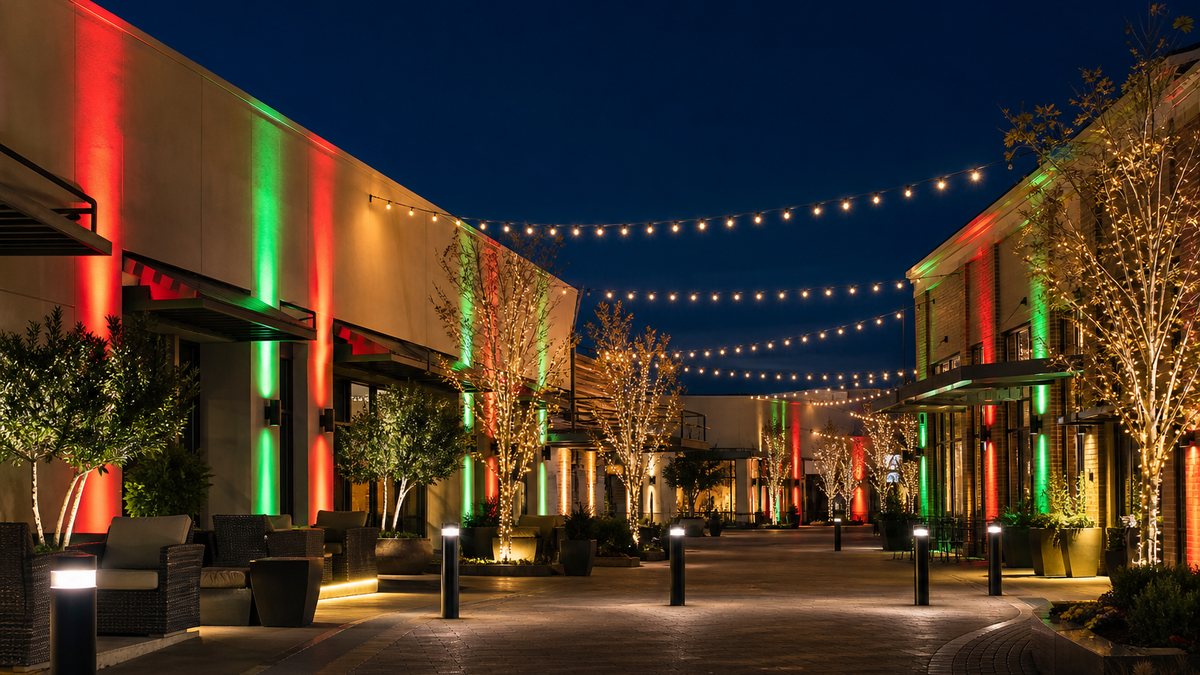
- Color-capable facade and tree lighting that can shift to holiday colors with a scene change, then return to warm white in January.
- Dedicated outdoor-rated power points near entries, plazas, trees and light poles for wreaths, garlands and pole-mounted decorations.
- Seasonal circuits on schedules so holiday displays switch on and off automatically with the rest of the site.
- Plaza and walkway string lighting designed with proper supports and outdoor-rated components, which can stay up year-round for patios and events.
- Digital signage content for holiday promotions, events and extended shopping hours.
Planning now for next year is also smart: walking the center during this holiday season shows exactly where power, mounting points and controls are missing.
Common areas, plazas and landscape
Many centers are adding outdoor seating, patios and small plazas to keep visitors on site longer. Layered lighting makes these spaces usable after dark: warm string or catenary lighting overhead, low bollards along edges, uplit trees and planters, and soft accent light on seat walls and water features. Dimmable scenes allow a plaza to be lively during evening events and calmer later at night. Read our guide to commercial landscape lighting in Irving for trees, paths and water features.
Service areas, safety and code
The back of a shopping center matters as much as the front. Loading docks, service drives, trash enclosures and rear doors need dependable lighting for safe deliveries and security. Full cutoff LED wall packs and area lights with motion response provide strong light when activity occurs and lower levels otherwise.
Inside, retail spaces also need code-compliant emergency and exit lighting along egress paths, with regular testing and records. Our guide to emergency and egress lighting in Irving explains what inspectors look for.
Built for North Texas conditions
Exterior retail lighting in Irving has to handle summer heat, heavy storms, lightning and long operating hours. When specifying fixtures, look for:
- Outdoor ratings and sealed optics that keep out water and dust
- Drivers rated for high ambient temperatures
- Surge protection on poles and exterior circuits
- Pole and bracket assessments before adding new fixtures, since older poles may need repair
- UV-stable finishes and lenses that resist yellowing
- Warranty terms and replacement part availability from the manufacturer
Planning a retail lighting upgrade
Shopping center upgrades succeed when they are planned around tenants and trading hours. A typical process looks like this:
- Site review and night walkthrough. Document existing fixtures, poles, controls, dark areas, glare, sign conditions and tenant concerns.
- Goals and priorities. Decide what matters most: safety, visibility, tenant appeal, energy, maintenance or all of them.
- Photometric design. Model parking and site lighting so new fixtures fix uniformity and glare instead of copying old problems.
- Fixture and control selection. Choose fixtures, optics, color temperature and controls for each area.
- Incentive review. Some projects may qualify for Oncor energy efficiency incentives, depending on program availability and project details.
- Proposal. A clear scope and project-specific price, with options for phasing.
- Phased installation. Exterior work scheduled to limit disruption, often outside peak shopping hours; interior work coordinated with each tenant.
- Aiming and programming. Night aiming, schedules and scenes set and documented.
- Ongoing service. Maintenance, control adjustments and seasonal changes.
If you are working with a tight budget, our guide to affordable commercial LED lighting upgrades in Irving explains how to prioritize upgrades by impact.
Owner vs tenant: who lights what
In multi-tenant centers, responsibility is usually split. The landlord typically handles the parking field, common walkways and canopies, building facade, pylon signs and service areas, while tenants handle their store interiors, storefront displays and individual signs. Lease terms vary, so it helps to define lighting standards in tenant criteria: approved color temperatures, sign illumination hours, display window lighting and control requirements. A coordinated program lets the landlord upgrade common areas while offering tenants a consistent path to upgrade their own spaces.
Common retail lighting mistakes
- One-for-one pole swaps without photometrics. New fixtures on old spacing can repeat the same dark spots.
- Too cold or too harsh. Very cool, glaring light makes a center feel institutional rather than welcoming.
- Mixed colors across tenants. Different color temperatures on canopies and signs make a center look patched together.
- Low-CRI interiors. Cheap fixtures can make merchandise look dull or off-color.
- Ignoring controls. Lights running at full output all night waste energy without improving safety.
- Forgetting the back of the center. Dark service areas invite problems.
- No plan for the holidays. Extension cords and temporary power every season are a safety risk and an eyesore.
Serving Irving retail corridors and nearby cities
We work with retail properties across Irving, Las Colinas, Valley Ranch and the DFW Airport corridor, from neighborhood centers to mixed-use developments, and in nearby communities such as Coppell, Grapevine and Grand Prairie. For Coppell and Valley Ranch properties, see our Coppell and Valley Ranch commercial LED lighting guide. Hotels and hospitality properties near retail districts can also review our hotel lighting guide.
Why work with Irving LED Lights
We design, supply, install, program and service commercial lighting across Irving and Las Colinas, including parking and site lighting, facades, signage, video walls and interior lighting, so every part of your retail property works together. Our team brings 15+ years as an authorized architectural lighting dealer and project coordinator, and our licensed installation partner has completed over 200 major sports and commercial projects across the US and Canada — NFL, NBA, NHL, MLS, NCAA and NASCAR. Explore our commercial lighting services, our Luminance design-build program, our Las Colinas commercial LED lighting guide, or learn more about us.
Frequently Asked Questions
What is the best lighting for a shopping center parking lot?
How much does a retail LED lighting upgrade cost in Irving?
What color temperature is best for retail stores?
Why does CRI matter in retail lighting?
Can LED lighting be installed without closing stores?
Should parking lot lights stay on all night?
Can shopping center lights change color for the holidays?
Are there incentives for retail LED upgrades in Irving?
Who is responsible for lighting in a multi-tenant center?
What areas do you serve?
Let's light your retail property
Request a consultation and we will follow up to schedule a site review and night walkthrough.
Related
Our DFW lighting network: Dallas commercial LED lighting, Fort Worth LED lighting, Arlington LED lighting, Plano LED lighting, statewide Texas LED lighting, custom LED signage, wholesale LED components, fiber optic starlight ceilings, 360° fiber optic lighting, modular building solutions, and Dallas modular structures.