Commercial Lighting Control Systems in Irving TX: The Complete 2026 Guide
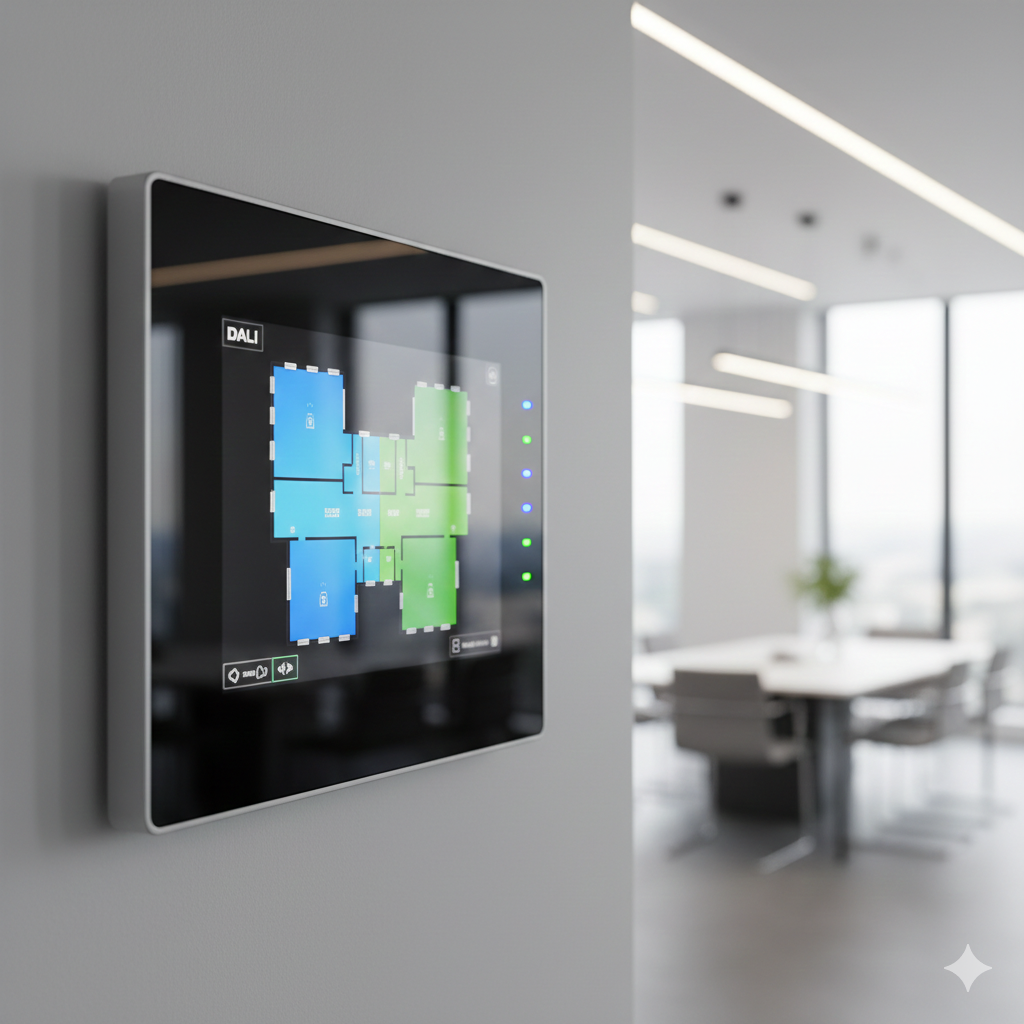
When you're managing a 500,000 square foot corporate campus in Las Colinas or building a new mixed-use development near Lake Carolyn, the lighting fixtures are only half the equation. The control system — how those fixtures communicate, dim, respond to occupancy, and integrate with your building automation — determines whether you achieve true performance or just expensive hardware collecting dust.
Commercial lighting control has evolved dramatically. The simple toggle switches and basic timers of a decade ago have been replaced by sophisticated digital protocols like DALI-2, wireless mesh networks, and AI-driven automation that can reduce energy consumption by 60% while improving occupant comfort. For Irving businesses competing for Fortune 500 tenants, intelligent lighting control isn't optional — it's expected.
This guide covers everything architects, facility managers, and developers need to know about commercial lighting control systems in Irving, Texas. We'll break down the protocols, compare technologies, and show you how to specify systems that deliver measurable results for large-scale commercial projects.
What Is Commercial Lighting Control?
Commercial lighting control refers to systems that manage when, where, and how much light is delivered in a building. Modern systems go far beyond on/off switches to include:
- Digital protocols (DALI-2, DMX512): Individual fixture addressing and bidirectional communication
- Dimming control: Smooth adjustment from 0.1% to 100% output
- Occupancy sensing: Automatic on/off based on room presence
- Daylight harvesting: Dimming artificial light when natural light is sufficient
- Scheduling: Time-based scenes and automation sequences
- BMS integration: Coordination with HVAC, security, and building systems
Why Lighting Control Matters for Irving Commercial Projects
Las Colinas hosts over 22 million square feet of Class A office space — the largest concentration in North Texas. Buildings here compete for tenants like ExxonMobil, Kimberly-Clark, and the newly-opened Wells Fargo campus. These companies evaluate every aspect of a building's operations, including lighting quality and energy performance.
Intelligent lighting control delivers measurable advantages:
Business Case for Lighting Control
- Energy reduction: 30-60% lower lighting energy costs through occupancy sensing and daylight harvesting
- Code compliance: ASHRAE 90.1 and IECC require automatic shutoff and dimming controls in commercial buildings
- Tenant attraction: Smart building features command premium rents and lower vacancy
- Maintenance efficiency: Remote diagnostics reduce service calls and identify failing fixtures before they fail
- Occupant productivity: Tunable white lighting supports circadian rhythms and reduces eye strain
We design and install lighting control systems for commercial projects throughout the DFW metroplex, including Dallas corporate towers, Fort Worth industrial facilities, Plano tech campuses, and Arlington mixed-use developments. For statewide commercial control system projects, Texas LED Lights provides comprehensive design and integration services.
Understanding Lighting Control Protocols
Choosing the right control protocol is one of the most important decisions in commercial lighting design. Each protocol has distinct capabilities, limitations, and cost implications. Here's what you need to know:
DALI-2 (Digital Addressable Lighting Interface)
DALI-2 Overview
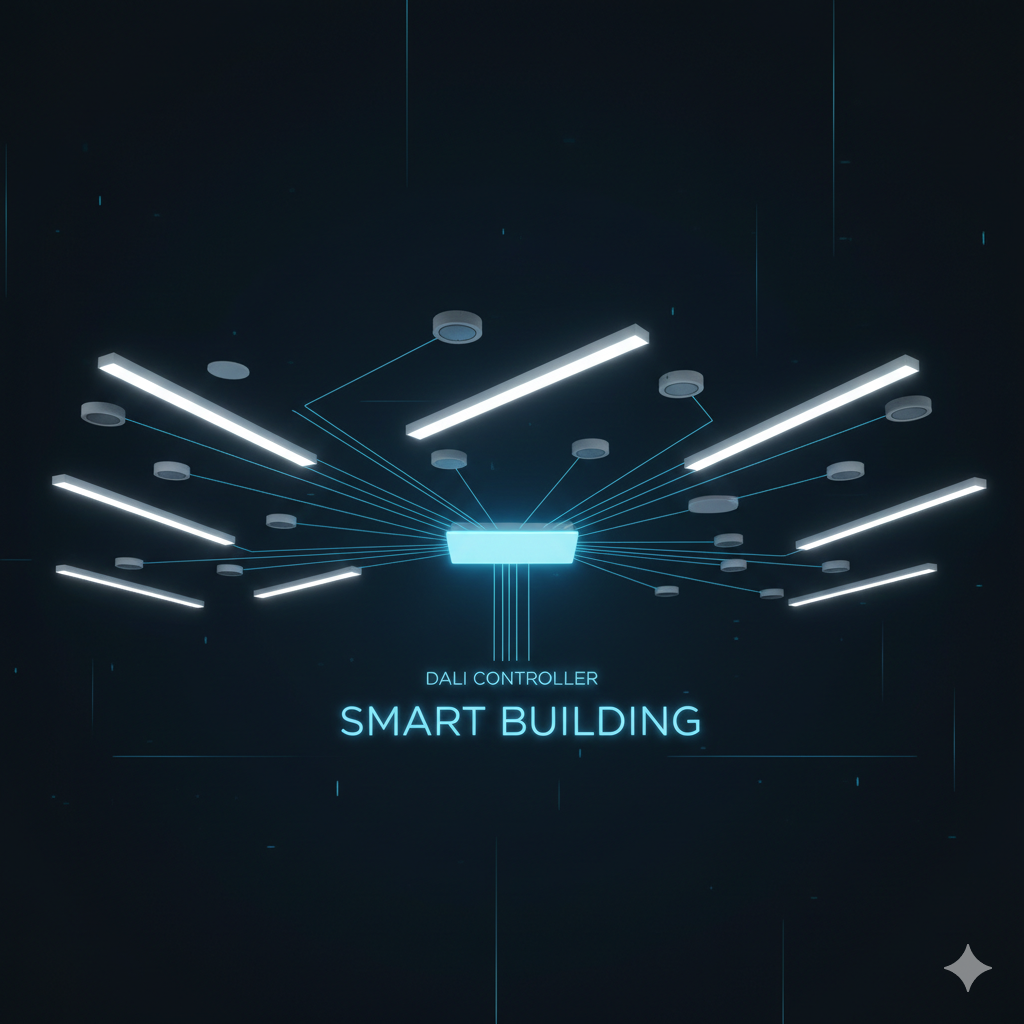
DALI-2 is the current international standard (IEC 62386) for digital lighting control. It provides individual addressing, bidirectional communication, and certified interoperability between manufacturers.
- Capacity: Up to 64 individually addressable fixtures per DALI line
- Communication: Bidirectional — fixtures report status, energy use, and faults
- Dimming: Logarithmic curve from 0.1% to 100%, flicker-free
- Grouping: 16 groups and 16 scenes per line
- Wiring: Dedicated 2-wire control bus (polarity insensitive)
- Best for: Large commercial projects requiring flexibility, diagnostics, and BMS integration
DALI-2 has become the standard for architectural-grade commercial lighting because it provides the flexibility to reconfigure zones through software rather than rewiring. When a tenant remodels their space, lighting groups can be adjusted without touching a single fixture.
The latest evolution, D4i, adds standardized power and data reporting within the luminaire, enabling fixtures to serve as data collection points for IoT applications.
0-10V Analog Dimming
0-10V Overview
0-10V is an analog dimming protocol where a low-voltage signal (0-10 volts DC) controls light output. It's simpler and less expensive than DALI but offers fewer features.
- Capacity: Multiple fixtures per zone (wired in parallel)
- Communication: One-way only — no status feedback
- Dimming: Typically 10% to 100% (varies by driver)
- Grouping: Hardware-based zones only
- Wiring: Dedicated 2-wire control circuit (polarity sensitive)
- Best for: Simple dimming applications, budget-conscious projects, retrofit
0-10V remains popular for warehouse high bays and basic office applications where sophisticated control isn't required. However, for large commercial projects in Irving where energy code compliance and BMS integration are requirements, DALI-2 is typically the better choice.
Wireless Control Systems
Wireless Overview
Wireless lighting control uses Bluetooth mesh, Zigbee, or proprietary RF protocols to eliminate control wiring. Systems like Casambi, Silvair, and Bluetooth NLC are increasingly popular for renovation projects.
- Capacity: Varies by system (typically 50-200+ devices per network)
- Communication: Bidirectional via mesh network
- Dimming: Full range, protocol-dependent
- Wiring: No dedicated control wiring required
- Best for: Retrofit projects, historic buildings, flexible/temporary installations
Wireless systems excel in renovation projects where running new control wiring is impractical or cost-prohibitive. Many modern systems now offer wireless-to-DALI gateways that bridge both technologies, allowing wireless sensors and switches to control DALI fixtures.
DMX512
DMX512 Overview
Originally developed for theatrical and entertainment lighting, DMX512 provides high-speed control for color-changing and dynamic lighting applications.
- Capacity: 512 channels per universe
- Communication: One-way (DMX) or bidirectional (RDM)
- Speed: High refresh rate for smooth color transitions and effects
- Best for: Facade lighting, architectural color, entertainment venues
For architectural facade lighting and RGBW color-changing applications, DMX512 remains the protocol of choice. We often specify DMX for exterior building accent lighting while using DALI for interior spaces. Learn more about our architectural fiber optic lighting capabilities for specialty applications.
Lighting Control Protocol Comparison
| Feature | DALI-2 | 0-10V | Wireless | DMX512 |
|---|---|---|---|---|
| Individual Addressing | Yes (64 per line) | No (zone only) | Yes | Yes (512 channels) |
| Bidirectional | Yes | No | Yes | With RDM |
| Dimming Range | 0.1-100% | 10-100% | 0-100% | 0-100% |
| BMS Integration | Excellent | Limited | Good | Limited |
| Reconfiguration | Software | Rewiring | Software | Software |
| Diagnostics | Yes | No | Yes | Limited |
| Cost per Fixture | $15-40 | $5-15 | $20-50 | $25-60 |
| Best Application | Large commercial | Basic dimming | Retrofit | Color/effects |
Key Components of Commercial Lighting Control Systems
A complete lighting control system includes multiple components working together. Understanding each element helps ensure your specification covers all requirements.
Lighting Controllers and Panels
The controller is the brain of the system. For small projects, this might be a simple DALI gateway. For large commercial buildings, dedicated lighting control panels house multiple DALI power supplies, relay modules, and network interfaces.
Controllers handle:
- Protocol conversion (DALI to BACnet, for example)
- Scene storage and execution
- Scheduling and astronomical time clock functions
- Integration with building management systems
- User interface connections (touchscreens, apps)
Occupancy and Vacancy Sensors
Occupancy sensors automatically turn lights on when a space is occupied and off after a timeout period. Vacancy sensors require manual on but turn off automatically. Energy codes typically require one or the other in most commercial spaces.
Sensor types include:
- PIR (Passive Infrared): Detects body heat movement — best for small spaces with clear sightlines
- Ultrasonic: Detects motion via sound waves — works around obstacles, covers larger areas
- Dual-technology: Combines PIR and ultrasonic for high-reliability applications
- High-bay sensors: Designed for mounting heights above 20 feet in warehouses

Photosensors for Daylight Harvesting
Photosensors measure ambient light levels and dim artificial lighting proportionally. Properly implemented daylight harvesting can reduce lighting energy by 20-40% in spaces with significant glazing — common in Las Colinas office towers.
Daylight Harvesting Best Practices
- Mount sensors to measure light at the task plane, not ceiling level
- Create separate control zones parallel to window walls (typically 15-foot depth)
- Calibrate setpoints during commissioning, not from default values
- Consider closed-loop (fixture-mounted) sensors for precise control
User Interfaces
How occupants interact with lighting affects satisfaction and system effectiveness. Modern interfaces include:
- Wall stations: Multi-button keypads for scene selection
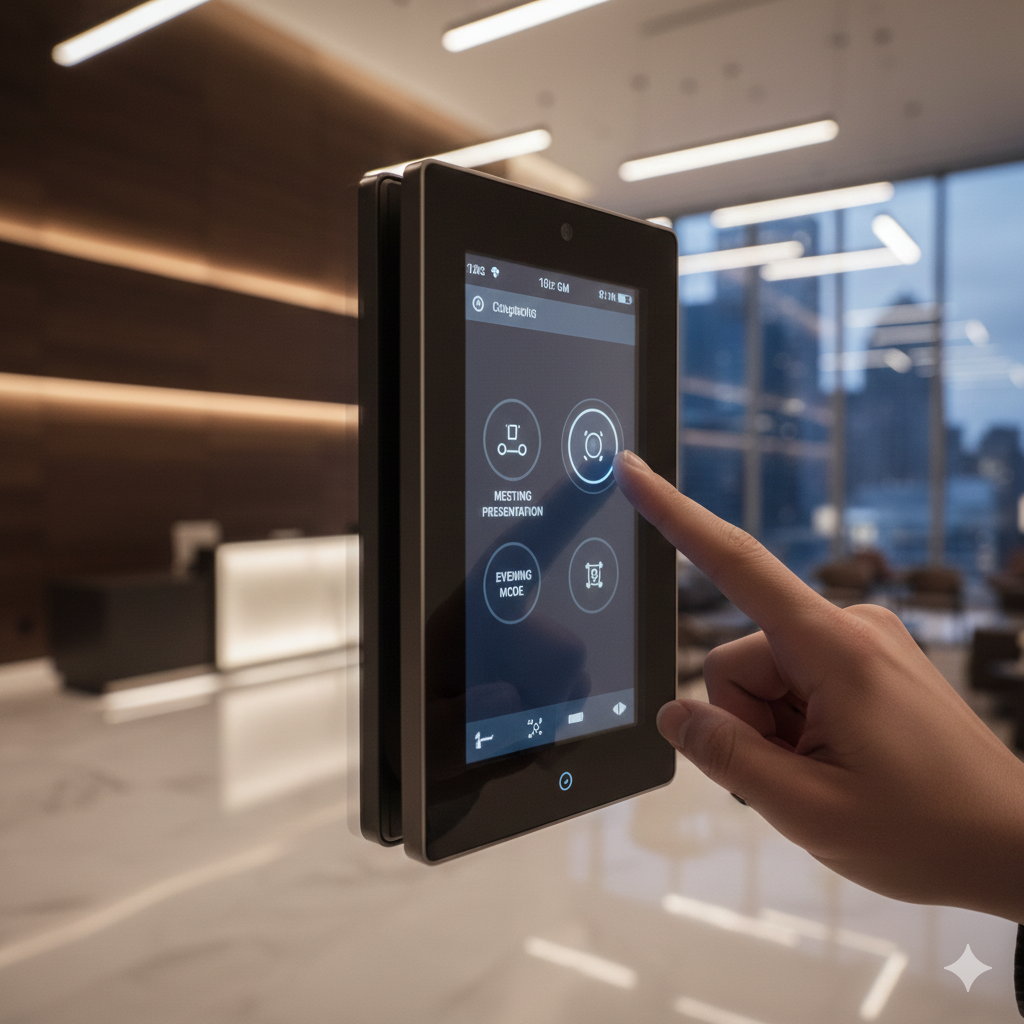
- Touchscreens: Graphical interfaces for complex spaces
- Mobile apps: Smartphone control for personal workspaces
- Voice control: Integration with building assistant systems
Building Automation Integration
For large commercial projects, lighting rarely operates in isolation. Integration with building management systems (BMS) enables coordinated control across multiple building systems.
Common Integration Protocols
- BACnet: The dominant protocol for commercial building automation — most DALI controllers offer BACnet IP or MSTP interfaces
- Modbus: Simple, reliable protocol common in industrial applications
- KNX: European standard increasingly used in high-end commercial projects
- REST API: Modern web-based integration for cloud platforms and custom applications
Integration Benefits
When lighting integrates with BMS, buildings can:
- Coordinate lighting with HVAC schedules — lights off = setback mode
- Respond to demand response events by dimming non-critical areas
- Integrate with access control — lights follow building occupancy
- Aggregate energy data for ESG reporting and ENERGY STAR certification
- Enable predictive maintenance through fixture health monitoring
We design lighting control systems that integrate seamlessly with all major BMS platforms. Our projects range from standalone DALI systems to fully networked installations coordinating with Tridium, Johnson Controls, Siemens, and Honeywell platforms.
Control Strategies for Different Commercial Spaces
Effective lighting control isn't one-size-fits-all. Different spaces require different strategies.
Open Office
- Daylight harvesting zones parallel to windows
- Personal control via app or workstation dimmer
- Vacancy sensing with 15-20 minute timeout
- Tunable white for circadian support (optional)
Private Offices
- Vacancy sensor (manual on, auto off)
- Full dimming range via wall station
- Scene presets (work, meeting, presentation)
- Optional daylight harvesting near windows
Conference Rooms
- Multi-scene control (presentation, video, meeting, cleaning)
- Vacancy sensing with extended timeout
- AV system integration for automatic scene recall
- Separate control of downlights, wall wash, accent lighting
Warehouses and Distribution Centers
- High-bay occupancy sensors with aisle-level control
- Scheduled dimming during low-activity periods
- Emergency egress integration
- High/low switching for 24/7 facilities
For large industrial facilities, we provide complete LED high bay installations with integrated controls. Projects across DFW include distribution centers, manufacturing plants, and logistics hubs requiring robust, reliable control systems.
Lobbies and Public Spaces
- Scheduled scenes coordinated with building hours
- Astronomical time clock for exterior transitions
- Dramatic lighting scenes for events
- Integration with feature lighting like starlight ceilings
Parking Structures
- Adaptive lighting — high output on occupancy, reduced when vacant
- Emergency egress compliance
- Photosensor control for transitional zones
- Integration with access control systems
Energy Code Compliance in Texas
Commercial buildings in Irving must comply with energy codes that mandate lighting controls. Understanding these requirements ensures your project passes inspection and delivers expected performance.
Key Lighting Control Requirements (IECC 2021 / ASHRAE 90.1-2019)
- Automatic shutoff: All spaces require occupancy sensors, timers, or scheduled shutoff
- Daylight responsive controls: Required in daylit zones (within 15 feet of windows)
- Multi-level lighting: Spaces over 5,000 SF require at least three lighting levels (including off)
- Exterior lighting: Automatic time or photosensor control required
- Parking garages: 50% reduction capability required in non-emergency fixtures
Meeting code minimums is straightforward with modern control systems. The real value comes from exceeding code to capture additional energy savings and qualify for certifications like LEED and ENERGY STAR.
Commissioning and Optimization
Even the best-designed control system requires proper commissioning to perform as intended. Studies show that 15-30% of expected energy savings are lost due to improper commissioning.
Commissioning Process
- Pre-functional testing: Verify all devices are installed, addressed, and communicating
- Functional testing: Test each control sequence under various conditions
- Calibration: Set photosensor setpoints, occupancy timeouts, and dimming curves
- Scene programming: Configure all preset scenes per design intent
- Integration testing: Verify BMS communication and coordinated sequences
- User training: Train facility staff on system operation and adjustments
- Documentation: Provide as-built drawings, programming records, and O&M manuals
We provide comprehensive commissioning services for all control system installations, including post-occupancy adjustments to optimize performance based on actual usage patterns.
Specialty Lighting Control Applications
Beyond standard commercial spaces, certain applications require specialized control approaches:
Facade and Architectural Lighting
Exterior building lighting often uses DMX512 for color-changing effects and RGBW fixtures. Control systems coordinate with astronomical time clocks and can change scenes for holidays, events, or branding purposes. For projects requiring precision fiber optic installations, visit 360 Fiber Lighting.
Video Walls and Digital Signage
Video wall installations require coordination between ambient lighting and display brightness. Control systems can automatically dim surrounding lights when displays are active and restore normal levels when content ends. Learn about our video wall installation services.
Pool and Aquatic Facilities
Underwater lighting requires specialized control for safety and aesthetics. DMX systems enable color shows and synchronized effects for hotel pools and commercial aquatic facilities. See our premium pool lighting solutions.
Frequently Asked Questions
Wholesale and Large-Scale Project Sourcing
For developers and contractors managing large commercial projects, Wiedamark LED provides wholesale pricing on DALI-compatible fixtures, drivers, and control components. Volume purchasing allows specification of architectural-grade products at competitive prices.
We also support contractors working on modular construction projects through partnerships with America Modular Buildings and Dallas Modular Structures, where lighting control systems can be pre-installed during manufacturing.
Ready to Specify Lighting Controls for Your Irving Project?
From DALI system design to BMS integration, we deliver commercial lighting control solutions for the most demanding projects in Las Colinas and DFW.
(702) 738-2218 Request Consultation